By Joyce Whitby

Our students’ first teachers in life are inarguably their parents. As educators, we have always known that parental involvement is directly related to student success. Because of the pandemic, many parents have a new perspective and appreciation for how their children learn best, or conversely, they have seen what doesn’t work as well.

As we build the foundation for recovery from lost instructional time, we are also focusing on rebuilding students’ social emotional wellness. Sharing this information with parents is critical, especially as we approach the summer school break. Just sharing the knowledge about how trauma affects the way children learn, and the way their brain allows them to function in a social and academic environment, is extremely valuable.

Trauma affects the way children learn, and the way their brain allows them to function in a social and academic environment. As parents and educators, the most essential aspect of teaching and learning is helping students develop the learning brain and use less of the survival brain on a daily basis.

The power of Trauma Informed and Restorative teaching strategies really multiplies when all members of a learning community come together to learn about and institutionalize best practices to:

  • Understand the different types of trauma
  • Recognize what trauma looks like in learners
  • Realize the differences between the “Learning Brain” vs the “Survival Brain”
  • Teach students strategies to deal with trauma induced emotions and anxiety

FREE RESOURCES TO DOWNLOAD:

  1. DeMystifying Trauma: Use this handy infographic to share basic info and generate awareness with faculty, staff and parents working with students as we all pull together to support social emotional health during this recovery period. DOWNLOAD 
  2. The Power of Language: Helpful reminders of how to choose words to encourage, support and build up students experiencing trauma. DOWNLOAD

REGISTER FOR FREE for our May 26, 2022 webinar De-Mystifying Trauma for Parents and the Learning Community https://www.brightenlearning.com/upcoming-webinars/

Social Emotional Learning (SEL) is the new buzz word used by every pundit and publisher these days. As special
educators, we have always addressed essential social skills based on each child’s individual needs. Though it is
wonderful that SEL is getting so much attention, and funding, it is critical to clearly define how to address SEL
within the context of maintaining compliance with Individual Education Plans (IEPs). One size does not fit all. This
blog post challenges readers to explore a continuum of developmentally appropriate social skills, as they build
IEP plans based on students’ needs vs a publishers’ catalog. 

Going Beyond SEL: Another way to look at how we can help our students accelerate recovery

By Joyce Whitby

April 2022

The abrupt shutdown of life as we knew it, just a little over two years ago, has taken its toll on so many aspects of everyday life. Our whole learning ecosystem – public, private, K12, higher education, virtual –  has been shaken not stirred!

As educators, we cannot afford to wait in order to build a thorough recovery plan that meets the unique needs of our very diverse learning population. The impetus now is to accelerate recovery, help learners master unfinished learning, and get them back on a “normal” trajectory for completing their education. Clearly the full impact and long-term implications are still being examined, and will be for years to come, but since we don’t have ability to time travel into the future and analyze that research, we need to build our recovery model now sans hard data.

Miraculously, the US Department of Education (US ED) immediately projected and recognized the overwhelming needs that would be forthcoming, and has instituted several layers of funding in waves of significant funding under CARES, CRRSSA and ARP*. What is truly significant with these funding guidelines, is that they specifically call out both a need to target “academic learning loss and social emotional learning”. There really has never been a time where mental health, and social emotional well being were as put on par with academics.

Though this is a most welcomed departure from the norm, it does open up a host of questions and even controversy around the areas of emotional wellbeing, which leaves with critical questions:

  • “What is SEL?”
  • “What isn’t SEL?”
  • “Who needs SEL? When? How often? Delivered by whom?”
  • “How do we measure the effectiveness of SEL?”

We are so anxious to get back to “normal”, that school leaders are jumping into this area feet first, regardless of the ambiguity around what SEL is, and what it is not. Hence the public outcry, from parents, and concerned community members, from politicians and the media has grown exponentially. Much of which is based on misinformation and lack of facts about what is included when we address the concept of SEL and how.

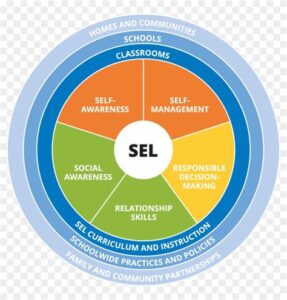
Long before the pandemic, in fact since 1994, The Collaborative for Academic, Social, and Emotional Learning (CASEL https://casel.org/) has been the de facto standard for explaining SEL via a framework commonly known as the “CASEL wheel.” At the center are five core social and emotional competencies, which are broad, interrelated areas that support learning and development. Circling them are four key settings where students live and grow. School-family-community partnerships coordinate SEL practices and establish equitable learning environments across all of these contexts.

Frankly, just diving into the research-based CASEL framework in isolation misses what we, as special educators, know is essential for students who are not performing at age-appropriate levels. That missing component is simple to base instruction on an individual’s needs. The “one size does not fit all” rule applies to everything we do in special education, so let’s look at how this should drive our approach to ensuring essential social emotional wellbeing is addressed appropriately. What we are missing as a whole in education is that we suddenly have a huge wave of students who were not previously classified with “special needs”, who now exhibit a host of issues that impede their ability to learn. No, we don’t need to classify each and every student, we need to intervene. Most of what we are seeing in the classroom of 2022 can be remediated, retaught, replenished, and restored.

If we peel back the fancy pedagogical language, the situation is a bit easier to understand. We have students across all grade levels, who have missed out on real time social interactions for two years. The importance of those interactions on the development of the whole child is greater than anyone ever imagined. Suddenly those students are back in a full-time classroom, after two years in an array of settings. It’s no wonder that they are demonstrating inappropriate behaviors. Students are breaking down in tears, or lashing out in frustration, as they encounter situations for which they are just not prepared to handle. Here are a few to consider:

  • Second graders don’t know the basics – how to line up, raise their hands to ask a question, or how to take turns. These are things that they would have learned and practiced in Kindergarten and 1st grade.
  • Middle schoolers that haven’t been around their peers for two years, are shocked to find that their friends are no longer little children, but rather, they are developing adolescents, with a host of complex social mores.
  • High School juniors and seniors are overwhelmed with tight timelines to comply with graduation requirements and college applications, even though they feel they just started High School.

The plot thickens as we consider teachers who have given every ounce of their being to helping students survive during remote and hybrid instruction. Those educators are also in need of respite, yet what they are encountering is a call to action to raise the bar even higher.

Given this reality, it is clear that everyone is dancing as fast as they can. Perhaps now is the right time to reset expectations, and address reasonable goals based on individual needs. Perhaps now is a great time to meet students where they are, and guide them along the path to pick up skills they missed. A great checklist of developmentally appropriate social skills and emotional competencies is available at Trauma-Sensitive Schools. Social and emotional competencies, such as self-regulation, strong coping and problem-solving skills, and positive social connections, buffer the effects of trauma and strengthen resilience. As we examine a student’s ability to manage themselves in socially appropriate ways, we can see areas that need direct instruction in social skills, coping skills, and life skills.

A tried-and-true mantra in Special Education is “teach to a student’s strengths to strengthen their weaknesses.” This is a great guiding principle for us to follow in terms of helping students during this time of recovery. All teaching practices should be appropriate to children’s ages and developmental status, attuned to each of them as unique individuals, and be responsive to the social and cultural contexts in which they live.

References

Collaborative for Academic, Social, and Emotional Learning (CASEL). (n.d.). CASEL (website). Retrieved from http://www.casel.org/

Developmentally appropriate social skills and emotional competencies checklist. Trauma-Sensitive Schools Training Package. https://safesupportivelearning.ed.gov/sites/default/files/TSS_Building_Handout_7_social_and_emotional_competencies.pdf

*Maximizing ESSER Funds in the American Rescue Plan Act to Prioritize Social Emotional Learning. Whitby, Joyce. Brighten Learning (website). https://socialexpress.com/wp-content/uploads/2021/03/Maximizing-ESSER-Funds-to-Prioritize-Social-Emotional-Learning_2022.pdf

Article written by Rachel Jameson

There are a number of challenges specific to social emotional learning (SEL) that parents and educators of children with special needs can face. Lack of experience with, and resources for, the specific and often complex ways a particular child relates to the world leads many to feel at a loss when it comes to these vital aspects of development.

So, to help combat these issues, let’s take a look at some strategies for bringing SEL into the broader learning process.

Become an astute observer

Knowing what will benefit any child in terms of SEL begins with a grounding in awareness of how they respond to peers in a range of situations. Children with special needs aren’t fundamentally different in this regard. However, the expression of negative and positive responses can take many forms — a few common examples are shifts in speech patterns, facial expressions or nervous tics, feeling unwell, or becoming quiet or withdrawn. Trigger stimuli that elicit a negative response are particularly worth paying attention to. How you then appropriately respond as the responsible adult should aim for consistency and positive outcomes for development.

Make use of learning apps

The revolution in digital technologies has been embraced by children, with even very young children usually being more than capable with the touch-screen interfaces that we’ve become used to. With this in mind, developers have carefully created a large plethora of apps such as the ones here at The Social Express, many of which are a hit with children with special needs such as those on the autistic spectrum. These apps can help students identify emotions and focus on social relationships in a low-stakes, fun and accessible way.

Integrate SEL into daily activities

Learning journeys are a marathon, not a sprint. Just like math, chemistry or gym, SEL is something we can always improve on incrementally, and as such it needs to become practiced on a regular basis. Apart from apps, this practice can take the form of activities in or out of the classroom such as the plenary, eventually becoming a part of lessons that many students are able to participate in with little prompting. Incorporating special needs flows from the first point about being observant, picking up on cues and understanding the student.

Consult a professional

There is no one-size-fits-all approach for social emotional learning, and this is perhaps even more so for special needs children. However, parents and educators shouldn’t be expected to simply intuitively know how to proceed. Professionals with a background in family studies are better equipped to understand and help solve the challenges that special needs children face. Educators with this training can help work with children to build the skills needed through SEL. And since learning happens inside and outside the classroom, parents can benefit from this type of training, too.

Create a plan

Depending on the child, it may or may not be necessary to develop an Individualized Education Program or IEP (something either a dedicated school Inclusion team member, or a suitably trained educator or parent, will be able to help with). A good IEP should involve the student directly with a focus on self-determination so that the goal is to maximize autonomy, and this has vital social and emotional components. Even if an IEP is not deemed necessary, setting a series of goals is a helpful way to parcel up larger goals that can otherwise be complex for students with special needs.

Article written by Rachel Jameson

Exclusively for THE SOCIAL EXPRESS

www.selday.org

 Register Now

March 25, 2021

2:00-3:00 pm ET

Social Emotional Learning:

Foundations and Integration Strategies

This webinar is designed to provide participants with a different focus on social emotional learning, emphasizing SEL as a foundation for all success, both social and academic. As we explore SEL as a building block, we will uncover strategies to transform environments with strategies that make sense and focus on success for everyone. Most importantly we will address the latest round of  Elementary and Secondary School Emergency Relief Fund (ESSER III funding) and how to ensure your plan addresses social emotional learning.


Who should attend?

 Anyone working with Pre-K-12th grade students – teachers, administrators, counselors, parent leaders

The Social Express

The Social Express has been focused on Social-Emotional Learning (SEL), Career Path Exploration and Life Readiness since 2010. Our cloud based animated programs use clever interactive simulations to teach learners how to be successful in life. Thousands of teachers worldwide are using The Social Express to help students feel less socially isolated and learn how to interact in our very social world. Now in 2021, given the reality of COVID19 pandemic quarantines and school closings, students need opportunities to learn how to relate to each other. Now, more than ever, we need to prioritize SEL and our students’ mental health.

PRESENTER: Karen Allen

Lifelong Educator and Trauma Informed Practices Advisor

Karen Allen has been an educator for over 20 years in the San Francisco Bay Area. After over 10 years in the classroom, Karen shifted her focus to supporting teachers as a curriculum specialist, and then later as a School Principal in Alternative Ed programs in Marin County, CA. Karen served as the Coordinator for the Marin County Office of Education’s Foster and Homeless Youth Education programs. Karen continues to be a lifelong education leader in Marin County and beyond, supporting teaching and learning communities through trauma informed practices and social emotional learning.


Educators have far exceeded all expectations during the most challenging school year in history

By Joyce Whitby

We support #SELDAY 2021 – March 26, 2021 – https://selday.org/

One silver lining about the school closings, quarantines and remote/hybrid learning  since March 2020 is that parents are more engaged in their children’s education than ever before in our history. Normally, parents are very engaged in early childhood education, elementary school and for students with special needs. We all know, however, that parents of neurotypical students tend to fade away in Middle School and High School. Partially because their burgeoning teen is actively pushing the parent away, demanding both privacy and control of their life.

For the past year the tables have been turned, and tweens and teens alike are at the kitchen table doing school work, with parents at their side. From an education perspective it is GREAT! Research shows that students with parents involved in their learning excel. From the parents perspective – they have a new sense of the amount of work their child is responsible for. From the students’ view it is mixed. Some students are really thriving in an environment that they don’t have to be quite so social. Others are lonely.

The problem is that we all collectively look at schools as a place to learn academics, which for the most part, is largely true. We really don’t have a good working definition for the purpose of schools. If we were to create a definition and say, “Schools are a place to learn academics.” We would be dead wrong. Immediately what comes to my mind is that this doesn’t include sports and the arts. Perhaps we could add in “School is a place to learn academics, sports and the arts”,  but again, we’d be wrong. We have seen literally millions of meals prepared and distributed to students in need over the past year, so I guess we could add in “Schools are a place to learn academics, sports, the arts and you get meals.” And yes, again we would be missing out on the essence of the school community which is so hard to nail down, because it is different from building to building, even in the same school district.

That essence is the “heart of a school” and it’s all about the expectations from each human being that enters that building. Even at virtual schools, the heart of the school is still about the expectations for genuinely caring about each other, respecting each other, and working together to learn and grow as a community. Granted, in some places this essence has been so buried for so long, it is hard to find. The words may be hung up on signs in the hallways, but they are posted as rules which must be adhered to at the risk of punishment. Again, during this unprecedented past year, this essence has been challenged like never before, as we prioritized connecting: students, disseminating academic lessons, and managing the ever changing schedule of A/B days, synchronous lesson time, asynchronous work time, deep cleaning, social distancing and wearing masks. It has been a superhuman feat by amazing educators nationwide (worldwide really) and it makes me lament for simpler days.

This makes me think about what I wished I had learned in school, and I’ll share a few thoughts with you. I wonder how many of these you will share with me?

When I was in school, I wished I learned that…

… my teachers were real people who didn’t live in the classroom when I went home at the end of the day (a misconception I cleared up by 3rd grade, yet I’ve met many folks who thought the same silly thing as a child.)
… it’s ok not to be best at everything, and that my best effort is what really helps me learn and grow
… my parents didn’t have the same benefit of a robust education that I had
… kids, who I thought were mean or snobbish, were just as frightened and shy as I was
… schools were for more than just the three R’s. They were also for learning how to be a good friend, a contributing member of a community, and an important part of an exciting new tomorrow and the world that was yet to be seen and explored
… that building my EQ (emotional quotient) was just as important as my IQ
… That social emotional learning (SEL) is important for everyone

I think about the students today and what they may have lost, and what they have definitely gained. If you have been reading my posts, you know I am an eternal optimist, thus, I believe that the lessons that students have learned will outweigh the temporary loss. The overarching lesson is that ‘when life hands you lemons you make lemonade’, and yes, this year was horrendous in terms of the loss of life and the disruption to our economy and routines like going to school every day, but we will emerge stronger, and more proficient at things we didn’t even know we could do.

As an educator and a parent, I think that the first thing we need to rebuild is that very precious “essence of our schools” and focus on basic mental health and emotional stability for all – students, teachers, parents, and staff. We can’t deny the trauma that we have all gone through, and yes, is still not over. We need to learn how to recognize the impact of that trauma, and work together to address the very real fears and stress that we carry, to find a common path out of this together. Let’s rebuild that essence of our school community brick by brick.  In short – SEL is more important now than ever before. 

By Joyce Whitby

We support #SELDAY 2021 – March 26, 2021 – https://selday.org/

If you are looking for an inspirational mantra for 2021 to guide as an overarching vision for your school, consider adopting this one – SEL for ALL. Never before have we had such a universal need for social emotional learning and a focus on nurturing and strengthening mental health.

It is really a shame that it took a global pandemic to illuminate this need. Perhaps it is one of those silver linings that has emerged? The impact of shuttering schools, locking down states, closing businesses, wearing masks, learning remotely, and watching the daily news track the growing number of Covid-19 cases and deaths, has raised awareness for many that clearly, social emotional learning is not optional this year.

___________________________________________________________________________________________________

If you are looking for a mantra for 2021 to guide as an overarching vision for your school, consider adopting this one – SEL for ALL.

___________________________________________________________________________________________________

To be clear, SEL should never have been considered optional. When learners are experiencing unbridled stress and trauma, they are not in “learning mode”, they are in “survival mode”. Until we address and help all stakeholders to find balance in their lives emotionally; we cannot begin to address academics.

What’s more, SEL is not just for students. Evidence suggests that we are all in need of mental health support: students of all ages and abilities, their teachers, everyone in the school community, including parents and guardians.

The whole concept of “closing the Covid-19 achievement gap” begins with opening up a dialog about mental health and well-being. Research shows that when students have opportunities for SEL, they have greater academic success, fewer behavior problems, and higher levels of positive social behaviors (Durlak, et al., 2011). So although we can’t control the traumatic circumstances, we can learn how to control our reaction to those circumstances. Once we embrace an attitude and practice of supporting each other through stress and trauma, we will clear the way for growth both from a social maturity perspective and academically.

____________________________________________________________________________________________________

Although we can’t control the traumatic circumstances, we can learn how to control our reaction to those circumstances.

____________________________________________________________________________________________________

Equity and SEL

You would have to have been living under a rock over the past 12 months to have missed Covid-19 and its impact on just about everything, especially schools. As previously mentioned, all stakeholders in the education community have had exposure to some level of stress, or trauma doled out by Covid-19. There are varying levels of stress and trauma depending on whom you are looking at, during what point of time in 2020, and where those individuals were located. The impact has been global and widespread, but alas not equitable.

Sadly, the disproportionate impact on communities of color and low socioeconomic standings is evident. These communities where subject to more cases of Covid-19 simply because of higher likelihood for underlying conditions, that worsened the impact of the virus, as well as the fact that they were more likely to be “essential workers” who were exposed at a greater rate than typical white collar workers who were asked to “tele-commute”. The fact is that these marginalized communities make up the majority, so it is logical that we should be talking about reaching everyone with SEL programs and resources. There should be no “haves” and “have-nots”. Plans should be all inclusive just because of the nature of the collective injury to us all. However, there is another big reason why we are talking about “SEL for ALL” – and that is because SEL just works better when done on a systemwide level.

Harvard Research shows that when schools implement an SEL focused program on a schoolwide basis, the impact is more visible and lasts for a longer period of time (Schafer, 2016). The findings of their five year study, consistently shows that a truly successful SEL program goes beyond the classroom walls, “all the adults in the building being trained in and familiar with a new vocabulary and practices that they can use in the hallways, in the gym, at recess, in the lunchroom, on the bus — all the times when kids have less structure, and are actually engaging in social interactions, when emotions are more likely to come up”.

Make “SEL for ALL” a Reality in 2021

To borrow a wise saying from Yoda “Do or Do Not, there is no try.” We have a chance, here and now, to commit to making mental health and social emotional well being a priority. Here are some easy suggestions for making “SEL for ALL” a reality in your school community this year:

  1. Invest in professional development that provides all members of the school community with better understanding to identify students struggling with stress and trauma, and how to be supportive, and re-engage students with their own learning career. Learn more about Trauma Informed Practices Professional Development –  Click here to request a 30 minute overview video.


2. Provide a common forum for students to explore and share their feelings. Create a safe zone for learning about and sharing feelings. Find and share common experiences virtually or face-to-face.

3. Legitimize SEL by giving it a space and place in your school culture. Create an SEL committee made up of members which are representative of the greater community. Include administrators, staff, teachers, aids, students and parents on that committee. Carving out time in your calendar and daily schedule not only prioritizes the intent and purpose, but it will free up time lost over more traditional behavior management that takes place after eruptions have occurred.

4. Inform and involve families. Parental support is always a critical factor for student success. Whether we are talking about academics, the arts, sports or social emotional health. Providing common language, skills and best practices completes the circle of support from caregivers for students. It’s the proverbial icing on the cake.

5. Rinse, re-evaluate, tweak and repeat. We are all a work in progress, and the way that you and your team manifest a healthy ecosystem will also be an evolution of thought and practice. You are bound to try some tactics which don’t serve you well. You may also be introduced to new approaches along the path. Carving out time to learn along the way just models what we aspire to impart together, step by step, a future full of possibilities for all.

Schedule a private tour of The Social Express and Cool School

By Joyce Whitby

References

Domitrovich, C. E., Durlak, J., Staley, K. C., & Weissberg, R. P. (2017). Social-emotional competence: An essential factor for promoting positive adjustment and reducing risk and school children. Child Development, 88, 408-416. doi:10.1111/cdev.12739 View the article.

Durlak, J. A., Weissberg, R. P., Dymnicki, A. B., Taylor, R. D. & Schellinger, K. B. (2011). The impact of enhancing students’ social and emotional learning: A meta-analysis of school-based universal interventions. Child Development, 82, 405–432. View the article.

Elias, M. J., O’Brien, M. U., & Weissberg, R. P. (2006). Transformative leadership for social and emotional learning. Principal Leadership, 7, 10-13. View the article.

Greenberg, M. T., Weissberg, R. P., O’Brien, M. U., Zins, J. E., Fredricks, L. et al. (2003). Enhancing school-based prevention and youth development through coordinated social, emotional, and academic learning. American Psychologist, 58, 466-474. doi:10.1037/0003-066X.58.6-7.466 View the article (log-in required).

Kopershock, H., Harms, T., de Boer, H., van Kuijk, M., & Doolaard, S. (2016). A meta-analysis of the effects of classroom management strategies and classroom management programs on students’ academic, behavioral, emotional, and motivational outcomes. Review of Educational Research, 86, 643-680. DOI: 10.3102/0034654315626799 Article available for purchase.

Miller, J. (2015). The power of parenting with social and emotional learning. Huffington Post, April 15, 2015. View the article.

Oberle, E., Domitrovich, C. E., Meyers, D. C., & Weissberg, R. P. (2016). Establishing systemic social and emotional learning approaches in schools: A framework for schoolwide implementation. Cambridge Journal of Education, 46, 277-297. doi:10.1080/0305764X.2015.1125450 Article available for purchase.

Osher, D., Kidron, Y., Brackett, M., Dymnicki, A., Jones, S., & Weissberg, R. P. (2016). Advancing the science and practice of social and emotional learning: Looking back and moving forward. Review of Research in Education, 40, 644-681. View the article.

Shafer, Leah. (2016) What Makes SEL Work? An effective social-emotional learning program has to be a whole-school initiative. Usable Knowledge Harvard Graduate School of Education. Cambridge, MA. View the article.

Sklad, M., Diekstra, R., Ritter, M. D., Ben, J. & Gravesteijn, C. (2012), Effectiveness of school-based universal social, emotional, and behavioral programs: Do they enhance students’ development in the area of skill, behavior, and adjustment? Psychology in the Schools, 49, 892–909. Article available for purchase.

Teitelbaum, Noah. (2020) Benefits of Schoolwide SEL, Empowering Education Blog post View the post.

Weissberg, R. P., & Cascarino, J. (2013). Academic learning + social-emotional learning = national priority. Phi Delta Kappan, 52, 8-13. View the article.

LEARN MORE about Trauma Informed Practices Professional Development:

  • Click here to request a 30 minute overview video
  • Click here to schedule a private tour of the Social Express and Cool School
Everything you need to know about
Trauma Informed Practices*

*but were afraid to ask

We support #SELDAY 2021 – March 26, 2021 – https://selday.org/

On any other day, any other week, any other year … posing a challenge to your students to study for an upcoming test, or to meet a deadline for a team research project might be met with moans and groans. But on this day, on this week, in this most unusual year of 2020, the well intentioned urgings of a teacher trying to set the bar high for her students, might just be the veritable “straw that breaks the camel’s back”. If you have found yourself wondering why a normally amicable student just had a total meltdown because of a simple everyday academic situation, you should read on.

* Disclaimer – This blog post may NOT ANSWER ‘Everything you need to know’, but hopefully it will lead you on the path to finding answers and methods that will work for you and help better understand how to deal with the unprecedented levels of stress now encountered in students, parents,colleagues and even yourself and your family. 

WHAT DO YOU KNOW ABOUT STRESS AND TRAUMA?

We are a very different America than we were just twelve months ago. Daily reports of rising COVID 19 rates clearly dominate headlines, and dwarf the news of typical “run of the mill” traumatic events. Events, which in and of themselves, can be devastating, include: physical or mental abuse, poverty, hunger, natural disaster, and violence of all sorts. Even the national election this year, and nationwide unrest regarding systemic racism and inequality, all contribute to what now amounts to daily trauma, which more and more people are sharing in 2020.

Stress triggers the body’s natural defense systems against predators and danger. It causes the body to flood with hormones that prepare its systems to evade or confront danger. People commonly refer to this as the “fight-or-flight mechanism”. Stress can be a motivator, and it can even be essential to

survival. However, when the body becomes triggered too easily, or and there are too many stressors at one time, it can undermine a person’s mental and physical health and become harmful. The impact is traumatic.

WHAT DO YOU NEED TO LOOK OUT FOR?

Students, and adults who are suffering from these different forms of trauma, present with an array of symptoms. Oftentimes symptoms are masked by the individual. Furthermore, the “detective work” that needs to happen in order to isolate and define stressors in any given situation takes time. Yet, as time passes, the process for assessing and intervening becomes more complicated.

Learning how to recognize the varying signs of these trauma is essential for every educator and administrator. It is no longer optional. Knowing more about the brain and how it reacts to trauma can exponentially improve effectiveness for identification and management of the impact of trauma.

Teachers need skills to identify and refer more difficult cases for additional support from mental health professionals, all while providing ample empathy, and creating a safe place to learn. Whew! That’s a tall order. For many educators, this is their reality and is especially true in this COVID 19 era.


SO WHAT CAN YOU DO?

Thus, the big question for educators is no longer “Has this student experienced trauma?” Rather the questioning should be along the line of “In addition to COVID 19, what other trauma has this student experienced? How is he or she dealing with it? Is it impacting their ability to learn? How can we best intervene to assist?” Here are just a couple of suggestions for comprehensive resources and strategies that can lead to building a culture and ecosystem of understanding, where healing can begin.

The National Dropout Prevention Center (NDPC) has an amazing model for certifying schools and districts as “Trauma-Skilled Schools” (TSS). A two year commitment to immerse all school site personnel in a five-step process. Just recently, they awarded Greenville SC a certification as a “Trauma Skilled School District.” This is an amazing accomplishment, and should yield great data that we can all learn from. Certainly something to aspire to and learn from.

LEARN MORE about the NDPC TSS program:

http://dropoutprevention.org/executive-summary-of-the-national-dropout-prevention-center-trauma-skilled-schools-model/ 

The Social Express produces a suite of award winning social emotional learning tools, and now also offers customized professional development to build both awareness and strategies for managing stress in our schools.  The goal is to prepare educators with the ability to identify students who need more help. A major part of this training is to provide practical and applicable skills for teachers. For instance how to use language that will help students feel they are in a trusted and safe environment.  The company offers a short 30 minute video which addresses some of these basics, and gives a good setup for the full 2.5 hour course.

LEARN MORE about Trauma Informed Practices Professional Development: 

    • Click here to request a 30 minute overview video
    • Click here to learn more about how to order this training

This is not easy stuff. It is not necessarily intuitive. It is time for everyone to learn more together, and lead all members of the learning community down a path of greater understanding, empathy and informed intervention.


During unprecedented school closures spring 2020, nearly a quarter of a million new users were enrolled online in The Social Express. This presented a perfect opportunity to learn more about how educators addressed social emotional learning (SEL) in remote learning environments. Specifically, we examined how SEL services were being delivered.  We were looking for best practices that we could share, as the likelihood is high that there will be further interruptions to traditional formal education moving forward, at least for the foreseeable future.

Read More

Why We Need to Support Social-Emotional Learning for All Our Students!

At a recent parent teacher conference a passionate teacher found herself explaining why she dedicates daily instructional time for activities to address topics of social and emotional learning (SEL), with the goal of strengthening her students’ overall emotional health and ability to interact socially in positive ways. Surprisingly, her presentation was met by a stark remark from one of the parents who said, “I never had SEL lessons in school and I came out alright!”

Somewhere over the past 50+ years we have finally figured out that education is not all ABCs and 123s. We have learned that separating the learning from the learner just creates angst, it doesn’t create lifelong learners. The new wave of interest in SEL is promising, and provides options for educators. How do we as educators who believe in teaching the whole child (including social and emotional skills) help others to understand why this is important – that is, how do we “sell” SEL instruction to all stakeholders including administrators, teachers, students and parents?

 What is SEL? Social and emotional learning (SEL) is the process through which children and adults acquire and effectively apply the knowledge, attitudes, and skills necessary to understand and manage emotions, set and achieve positive goals, feel and show empathy for others, establish and maintain positive relationships, and make responsible decisions (CASEL). In order for students to develop the knowledge, attitudes, and skills described in SEL, students need to be competent, or have abilities, in five areas: self-awareness, self-management, social awareness, relationship skills, responsible decision making.


The Importance of Social Learning

Our world is a social place, and we spend most of our time as members of social groups. We all use our social skills everywhere we go. Social skills are about sharing space with others and being able to get along with people in a variety of settings. An individual’s social success is based upon the quality of his or her social interactions. In order to have positive social interactions, an individual needs to be socially competent and have strong social learning skills.

Education in the United States has matured since the passing of Title I in 1965, we now look for research-based instructional practices and data based decision making. Accountability is not a foreign concept, in fact it is right up front and center stage. When we look at building a case for justifying SEL instruction, we can include some amazing data. In fact, research shows that SEL not only improves achievement by an average of 11 percentile points, but it also increases prosocial behaviors (such as kindness, sharing, and empathy), improves student attitudes toward school, and reduces depression and stress among students (Durlak et al., 2011).

The role of technology in reaching students who are socially ‘challenged’

In today’s world technology is a natural medium for just about any student to help them learn and engage in new concepts. Technology offers an opportunity to experiment in real life scenarios without any dangerous consequences. Simulated personal interactions afford students a safe haven to learn more about those non-intuitive things – like learning body language, picking up on sarcasm or other verbal nuances which are not very clear.

Introducing The Social Express

In a safe and familiar learning environment, The Social Express animated interactive program provides students an opportunity to learn and practice skills needed to help them develop meaningful relationships and successfully navigate our social world. The Social Express was designed for students to use at school or home, and provides educators and parents with insightful data about students’ growth in key areas of social emotional learning.

In over 80 animated interactive lessons, The Social Express aligns with basic tenets of Universal Design of Learning (UDL)  by offering different types of learning methods including online and offline activities.  In addition, The Social Express is both research-based and research-backed! A research study with over 350 students concluded there were statistically significant improvements for students when the implementation was part of a schoolwide initiative.

Each “webisode” teaches foundational skills for social and emotional learning such as:

  • Attentive Listening
  • Conflict Resolution
  • Conversations
  • Critical Thinking
  • Group Participation
  • Non-Verbal Communication
  • Relationship & Self Management

The best part about The Social Express is that even though you might have to “sell SEL” to other adults, you never have to sell it to the students themselves. The interactive lessons are engaging and fun. Countless testimonials concur that the application is awesome! Thousands of teachers worldwide are using The Social Express to help students feel less socially isolated, and learn how to interact in our very social world.

By Joyce Whitby

@jwhitby1 joyce@innovations4education.com

References:


[vc_row][vc_column width=”2/3″][vc_column_text]“You’re having twins!” Can you imagine the excitement?

In 2001, Jared and Jason Zimmerman, were born to my amazing wife Tina and me.  Our first thoughts were we would need two of everything, that our families were going to be completely surprised, and of course, this could get expensive!  Needless to say, no matter how much you plan for two babies, there are going to be some challenges, and some curveballs, that will come your way…

We just had no idea the information we would receive two years later.

In 2003, Tina and I were well on our way regarding parenting, play dates, bottles, diapers, etc.  It was the normal process of raising a family.  Sure, there were the sleepless nights, and the challenge of trying to get Jared and Jason to sleep and eat at the same times.  Everything we did was multiplied by two—and while we thoroughly loved it, costs were creeping up, and we realized that planning for the kids’ future needed to start now.  One of our closest friends suggested we contact a Hollywood Talent Agent to represent the kids for TV or Print advertising work.  This would be a great way to start putting some money away for college and other expenses as the kids got older.  You see, Jared and Jason are not only identical, but they have the “California Surfer” blonde hair with flowing locks, beautiful smiles, and just all around cuteness.  We could barely go anywhere without being stopped by people gushing over our kids—they were Rock Stars!  Figuring there was no harm in investigating this avenue, we went and met with a high profile casting agent.[/vc_column_text][/vc_column][vc_column width=”1/3″][vc_single_image image=”345″][/vc_column][/vc_row][vc_row][vc_column][vc_column_text]The meeting with the casting agent was intense for Tina and me.  Would they like our kids?  Could the boys “pass the test?”  The answer to these questions came sooner rather than later, and some additional insight would change our lives forever.  The agent loved the boys, and would sign them to a contract tomorrow, but she was concerned that they had trouble communicating.  When she tried typical prompts that the kids would be met with in a professional setting, there was nothing, just a blank look on their faces—no pointing, no looking, no ability at all to follow directions. “I am sorry, but there is no way I could put your boys on a set,” she told us…

Truth be told, this wasn’t the first time someone had mentioned to us that our boys may have some delay in their development, but who wants to hear that?  Perhaps, because they were identical twins, this was somehow normal and they would “grow out of it.”  Even when our own pediatrician told us the boys were not developing at a normal rate, we really didn’t want to hear it; we told ourselves to just keep moving forward and everything would be fine.  But our meeting with the casting agent was our tipping point, and we realized that we needed to address the situation.

After understanding what autism was (we had no prior experience with this whatsoever), it quickly hit me that my twins were not going to be like Tina and me.  We are both highly social and have no problems talking to anyone; however, this wouldn’t be the case for our Jared and Jason.

It then became my mission to try and help the twins with social skills first and academics second.  After making several attempts to use the current tools and not seeing any change, I was beginning to accept that there may not be anything to help them.  Then one day, during a therapy session at our home, I saw the twins working on a computer doing some drills.  They were smiling and engaging like I had never seen before. Prior to this, it was all flash cards—nothing “high tech.”[/vc_column_text][vc_single_image image=”346″ alignment=”center” css=”.vc_custom_1552595833303{padding-top: 20px !important;}”][/vc_column][/vc_row][vc_row][vc_column][vc_column_text]That moment changed my life forever.  I thought if I could come up with a way to engage Jared and Jason by using the computer, focusing the content on social skills, perhaps they would, at a minimum, be engaged and hopefully generalize what they saw and apply it to everyday life.

After dropping Jared and Jason off at school, I had the idea of making a software program that “looks and feels” like an animated Pixar movie – something all kids love! Additionally, the program would have the ability for the kids to touch the screen and directly interact and engage with it.  All I had to do now was convince my wife Tina, because this would require going into our nest egg.  It didn’t take much convincing, after all; if it worked, it would not only benefit Jared and Jason, it could go on to help countless others. It was a no-brainer, and The Social Express was born.  Committed to this newfound goal, we brought together an advisory board of top therapeutic and educational professionals who were certified in helping kids with special needs.  Then, we sought out animators and other tech experts who would help bring this dream to life.

From preschoolers to high schoolers, The Social Express software provides research-based, animated, interactive lessons and encourages users to practice real-life social interactions. The Social Express® targets core deficit areas that stand in the way of school, social interactions, and life success for children and young adults with social learning challenges. The software addresses these areas of need by providing a highly interactive and visual presentation, utilizing an additional component that allows for the generalization of skills outside of the teaching environment.

Most recently, The Social Express has been included in the latest version of the National Education Technology Plan 2016 – Future Ready Learning: Reimagining the Role of Technology in Education.  Updated every five years, the National Education Technology Plan (NETP) is the key educational technology policy document for the United States.  The Social Express is cited in the report’s chapter on “Engaging and Empowering Learning Through Technology” as an example of a digital solution to help build non-cognitive competencies.

What started as an idea to help our boys has now grown to help so many more and continues to grow and evolve. To make a difference is truly an awe-inspiring feeling for both Tina and me.

Marc Zimmerman has been working with his twin autistic sons in all aspects of therapy and education planning, successfully helping them to transition from the special education classroom to the mainstream classroom. Previously, Marc was founder and President of Critical Digital Data, Inc. (CDIX, OTC:BB), an online data storage company; CEO of 1st Financial Home Loan Services, a high-end boutique mortgage brokerage that was sold in 2005; and CEO-Founder of Pineapple Hut Real Estate, a multimillion dollar-producing real estate brokerage. Marc attended the Berkeley School of Music in Boston. He is a highly accomplished keyboardist, pianist, and composer with worldwide recording and touring credentials.

Visit  www.thesocialexpress.com to learn more about the software.

This article was featured in Issue 53 – Working Toward The Future[/vc_column_text][/vc_column][/vc_row]