[vc_row][vc_column][vc_column_text]Kids love their devices. Basic web-enabled devices – laptops, smartphones, and tablets – open a universe of learning for children. Kids with autism spectrum disorder can have a high degree of digital readiness, and find device learning second nature.

Autism refers to a set of complex disorders in brain development. A government survey in November 2015 revealed one in 45 American kids aged 3 to 17 have an ASD diagnosis. A Centers for Disease Control and Prevention survey estimated 1 in 68 has autism.

Children on the Autism spectrum often struggle in:

  • SOCIAL INTERACTION | How do two or more people relate? It’s observed one-on-one, in small groups, or large groups. It’s where institutions, rules and systems take root.
  • REPETITIVE BEHAVIORS | How do they manifest in development? Repetitive behaviors can include hand-flapping, head-banging and rocking.
  • VERBAL AND NON-VERBAL COMMUNICATION | How do we relate with and without words? We send and receive information through verbal and non-verbal cues. It could be face-to-face, through body language, written word, visuals, and more.

We’ve found these apps helpful for children diagnosed with autism. They can also aid their parents, teachers and therapists.

Learn more about these as well as what the creators and developers had to say when we reached out to them![/vc_column_text][vc_separator css=”.vc_custom_1552596336850{padding-top: 16px !important;padding-bottom: 16px !important;}”][vcex_heading text=”FOR CHILDREN” tag=”h4″ css=”.vc_custom_1552596393824{margin-bottom: 0px !important;padding-bottom: 0px !important;}”][/vc_column][/vc_row][vc_row][vc_column width=”2/3″][vc_column_text]Autism / DTT Colors | Dr. Brown’s Apps
DrBrownsApp.com | iTunes ($7.99)

This site offers a set of apps designed to build student skill sets. Categories include Animals, Anti-Bullying, Colors, Letters, Numbers, People, Shapes, Time, and Words. The Discreet Trial Training apps incorporate findings from Dr. Brown’s years of experience in psychological therapy. When reached for comment, they had this to say:

At Dr. Brown’s Apps, we have built our app design on over 40 years of Dr. Brown’s psychological therapist experience in a clinical setting.[/vc_column_text][/vc_column][vc_column width=”1/3″][vc_single_image image=”362″ alignment=”center”][/vc_column][/vc_row][vc_row][vc_column width=”2/3″][vc_column_text]Digital Problem Solver | The Social Express
TheSocialExpress.com | iTunes ($1.99) | Google Play

Users identify feelings from a set of emotions. Then, they move into a coping strategy as the next step in self-regulation. Download your own photos to customize animated, interactive lessons that focus on social relationships. Users learn to read verbal and non-verbal cues, and take part in conversations. We asked them to comment further on their apps and they commented:

We use high quality animation and engaging characters and stories, to effectively deliver the essential elements of social and emotional learning to a population that have difficulties with understanding social cues, or have trouble with managing their emotions.[/vc_column_text][/vc_column][vc_column width=”1/3″][vc_single_image image=”358″ alignment=”center”][/vc_column][/vc_row][vc_row][vc_column width=”2/3″][vc_column_text]Learn with Rufus: Emotions | Rufus the Robot
Rufusrobot.com | iTunes ($4.99) | Google Play ($5)

Kids learn how facial expressions reveal what people feel, with guidance from Rufus Robot. “The inclusion of reward sets and breaks in our apps will keep the child’s interest while he or she learns,” said Dr. Holly Gastgeb, Rufus Robot President and CEO. Dr. Holly Gastgeb also shared:

Research has repeatedly shown that children respond to mobile devices at a young age. Our goal is to capture some of that enthusiasm and direct it in a fun, yet educational, manner. Emotions includes a brief fingerpainting activity that will keep the child’s interest while he or she learns.[/vc_column_text][/vc_column][vc_column width=”1/3″][vc_single_image image=”363″ alignment=”center”][/vc_column][/vc_row][vc_row][vc_column width=”2/3″][vc_column_text]Look In My Eyes 1 Restaurant | Fizzbrain.com
Fizzbrain.com | iTunes ($2.99)

Creators David and Abbie Cort develop apps for all children. They have an interest in those for kids with special needs. The Look in My Eyes series keys on social skills, such as practicing eye contact. CBS’ 60 Minutes has featured FizzBrain apps.

Fizzbrain also shared their thoughts and feelings regarding their featured apps:

FizzBrain is a mom-and-pop studio committed to bringing the latest and very best of educational practices into the world of apps. Between the two of us, Abbie and I have over 50 years’ experience teaching in elementary, secondary and special education classrooms, and we draw on all this experience and training as we design our apps. […] We started FizzBrain in order to develop quality iPad/iPhone applications for all children based on best teaching practices. Our “Touch and Write” series has received numerous commendations and awards.[/vc_column_text][/vc_column][vc_column width=”1/3″][vc_single_image image=”360″ alignment=”center”][/vc_column][/vc_row][vc_row][vc_column width=”2/3″][vc_column_text]My School Day & Social Detective | Social Skill Builder
Socialskillbuilder.com | iTunes (My School Day $9.99, Social Detective $24.99)

Social Skill Builder transitioned award-winning CDs for ASD students to apps. Interactive software includes video scenarios that encourage users to interact with peers. The popular Social Detective app engages a student’s sense of adventure and problem-solving.

Among the glowing testimonials for these programs is this one from from an ABA Therapist from the Penn State Austism Conference:

I worked with ASD students on social skills and your My School Day CD as well as the Social Detective CD are my go to materials. I have both in CD form and am glad they are now available in apps. Easier to transport. The kids really love them especially the Social Detective App and really learn so much from them.[/vc_column_text][/vc_column][vc_column width=”1/3″][vc_single_image image=”361″ alignment=”center”][/vc_column][/vc_row][vc_row][vc_column][vcex_heading text=”Other Gadgets” tag=”h4″ css=”.vc_custom_1552596847910{margin-bottom: 0px !important;padding-bottom: 0px !important;}”][/vc_column][/vc_row][vc_row][vc_column width=”2/3″][vc_column_text]Dreampad | Integrated Listening Systems
Dreampadsleep.com

Integrated Listening Systems’ headphone technology had relaxing effects on kids with autism. Headphones present a challenge, though, for those with tactile sensitivity. Enter Dreampad, a pillow with psychoacoustic technology. Dreampad looks and acts as a pillow, but does much more.

A music app produces calming music from within. It creates gentle vibrations to trigger the user’s relaxation response. It shows improved sleep habit for those on and off the spectrum. Improved sleep can impact daytime behaviors for children with autism.

iLs developed the Dreampad after observing the powerfully relaxing effect of the iLs headphone technology on children with autism. Tactile sensitivity is very common with autism, and many of the children couldn’t tolerate iLs headphones. We learned quickly that the Dreampad not only reduced anxiety, but improved sleep habits with the vast majority of those on (and off) the spectrum.[/vc_column_text][/vc_column][vc_column width=”1/3″][vc_single_image image=”357″ alignment=”center”][/vc_column][/vc_row][vc_row][vc_column][vcex_heading text=”FOR PARENTS, TEACHERS AND THERAPISTS” tag=”h4″ css=”.vc_custom_1552596908186{margin-bottom: 0px !important;padding-bottom: 0px !important;}”][/vc_column][/vc_row][vc_row][vc_column width=”2/3″][vc_column_text]Cognoa
Cognoa.com

This evaluation tool tests a child’s development first. It includes an optional video evaluation and detailed results to share with a pediatrician. “Providing parents with a validated path to early answers not only saves money and time in appointments, but (also) allows parents to remain focused at work,” said Brent Vaughan, Cognoa CEO. Brent Vaughan also stated:

Cognoa for Employers is putting the power of early screening in parents’ hands while giving employers the opportunity to provide competitive health benefits beyond normal employee expectations. With developmental delay affecting one in six U.S. children and autism affecting one in 68, it is no wonder that developmental milestones and potential delays consistently rank as top concerns for parents.[/vc_column_text][/vc_column][vc_column width=”1/3″][vc_single_image image=”365″ alignment=”center”][/vc_column][/vc_row][vc_row][vc_column width=”2/3″][vc_column_text]Social Stories Creator and Library | Touch Autism
Touchautism.com | iTunes (free)

Visual supports, such as stories, give direction instruction on social skills. This app provides that for kids with autism. It includes social stories to teach what to expect in an array of situations. Caregivers can create, print, and share customized social stories and visual schedules. The Social Stories Creator and Library folks had this to say:

Children with special needs often need more direct instruction of social skills. Teaching social skills to any child may be easier and less stressful when visual supports, like social stories are used. The social stories found in this app explain accurate social information and ensures that your child will know what to expect in different situations.[/vc_column_text][/vc_column][vc_column width=”1/3″][vc_single_image image=”356″ alignment=”center”][/vc_column][/vc_row][vc_row][vc_column width=”2/3″][vc_column_text]TOBY Playpad | Autism West
TOBYplaypad.com | iTunes ($25.99)

The TOBY (Therapy Outcomes By You) app contains an extensive curriculum. It includes solo on-screen and partner on-screen tasks, and real-world tasks for early intervention. The app collects data for performance reports on a child’s activity from the comfort of home.

Autism West is committed to supporting families to provide the best opportunities for their child. Our TOBY app is a revolutionary, unique way for parents to become empowered to implement therapy at home. It is best-practice and evidence-based, developed in conjunction with Curtin and Deakin Universities.[/vc_column_text][/vc_column][vc_column width=”1/3″][vc_single_image image=”364″ alignment=”center”][/vc_column][/vc_row][vc_row][vc_column][vc_column_text]About the Author
Eli Pacheco is a soccer coach and dad blogger. He studied English at the University of North Carolina at Charlotte, and writes about all things tech for Shortcut.

Sources:
https://www.autismspeaks.org/science/science-news/new-government-survey-pegs-autism-prevalence-1-45[/vc_column_text][/vc_column][/vc_row][vc_row][vc_column width=”2/3″][vc_column_text]The Autism Discovery Tool: Sensory From Within | Spectrum Idea Lab Inc.
Spectrumidealab.com | iTunes ($4.99)

Sensory issues might be the most misunderstood aspects of life on the spectrum. This play-based app provides an exploration of challenges and strengths in seven sensory experiences. The app environment provides hidden tools that shed insight to real-world sensory-environment strategy.

When setting out to create this app, our team at Spectrum Idea Lab identified that there was a significant lack of understanding about the sensory issues that often accompany autism, amongst families, teachers, and even those on the spectrum! So we created this exploratory, play-based app which immerses users into seven sensory experiences that demonstrate some of the sensory diversity found on the spectrum, including both strengths and challenges.[/vc_column_text][/vc_column][vc_column width=”1/3″][vc_single_image image=”359″ alignment=”center”][/vc_column][/vc_row]

In this installment of Stories to Inspire, the focus is on the D’Eri family, who are currently challenging the stigma regarding autistic employees. Their inspiring story appeared on upstanders.starbucks.com, a blog created by Howard Schultz and Rajiv Chandrasekran. The site profiles groups positively impacting their communities, and the D’Eri family is no exception. With an autistic son named Andrew, the D’Eris have struggled to find a future for him outside of the family environment. After Andrew was diagnosed at two years old, the family went through the usual stages of denial and eventual acceptance regarding his condition. But as the years went on, Andrew’s father, John, began to worry about his future.

According to the article, John has always felt that Andrew was capable of becoming more independent and could contribute to society without the stigma of autism holding him back; however, the question was how. After a visit to a local car wash, John realized that it could be a suitable work environment not only for Andrew, but for other adults with autism. To test this theory, John did more research. He eventually found a vocational school in Florida, named CarWash College, that specialized in training employees for car washes. John explained his idea to Paul Fazio, the head of Sonny’s Enterprises Inc. (an equipment company that owned the college), and the two decided to run an experiment to see if the idea was feasible. For five weeks, the two men trained 15 autistic individuals through a highly structured, step by step process. The training was broken down into short, simple lessons to ensure that the recruits would be able to fully develop the necessary skills. Soon, it was finally time to properly test John’s experiment.

The 15 trainees were employed at Fazio’s car wash, and John surveyed each customer’s experience with the service. After a short while, John noticed that the employees were working productively within the structured environment of the car wash and were even engaging well the customers. By the end of the experiment, their findings were nothing but positive: 95% of the customers reported having a good experience and would recommend the service to others. With this positive backing, John not only wanted to prove that autistic employees could function in a work environment, but that such a business could also be profitable. With this in mind, the D’Eris moved to Florida and purchased a local car wash in order to employ locals with autism, including Andrew.

All of the employees went through a similar training process, and soon their car wash (appropriately named Rising Tide) opened its doors to the public. John decided not to promote the fact that their employees were autistic at first to show that they could blend in with normal workers. After a couple of weeks, the results began to surprise the D’Eri’s. All of the autistic employees were diligent, focused workers that truly cared about what they were doing. They interacted well with customers, came into work on their off days, and they even began to form friendships with each other. Tom D’Eri, Andrew’s brother, also began to work for Rising Tide in order to bring the whole family together.

After a few months the car wash became profitable, spurring John to open up more Rising Tides and divulged their real mission to the public: helping to provide more employment for autistic adults. The D’Eris, with their vision and dedication, have managed to create a better future for Andrew, who loves his new job and the friends he has made in the process. As their work continues, the stigma regarding autistic employees will continue to improve as more people recognize that autism is not a limitation, but instead just a different approach.

How do you think we can continue this amazing effort and help employ more people with disabilities?

cropped-Sepcial-Education-degrees


A great post by Cara Delany

Science of Learning Disabilities
Source: Special-Education-Degree.net

Learning Disabilities in the U.S.

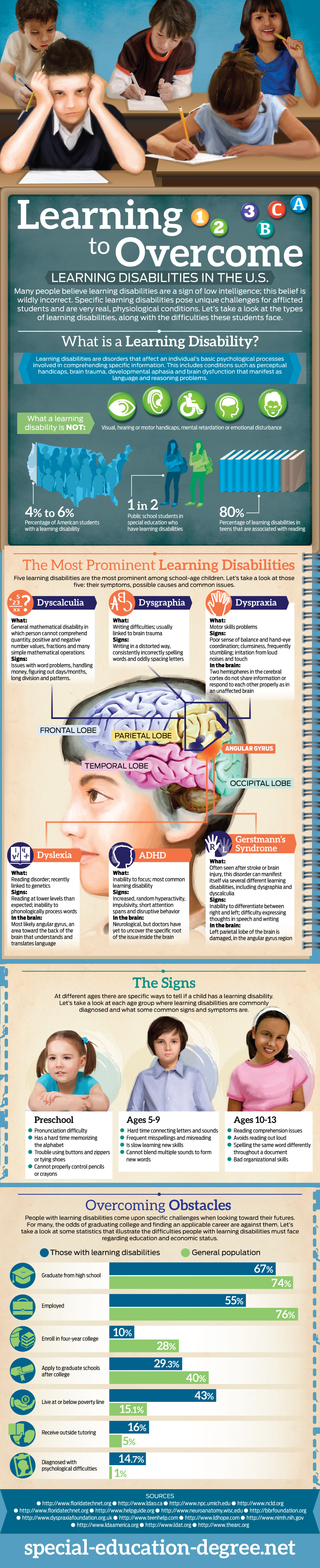
Many people believe learning disabilities are a sign of low intelligence; this belief is wildly incorrect. Specific learning disabilities pose unique challenges for afflicted students and are very real, physiological conditions. Let’s take a look at the types of learning disabilities, along with the difficulties these students face.
What is a Learning Disability?

Learning disabilities are disorders that affect an individual’s basic psychological processes involved in comprehending specific information. This includes conditions such as perceptual handicaps, brain trauma, developmental aphasia and brain dysfunction that manifest as language and reasoning problems.

What a learning disability is NOT:

Visual, hearing or motor handicaps, mental retardation or emotional disturbance

4% to 6%

Percentage of American students with a learning disability

4.6 million

People in the U.S. with learning disabilities

1 in 2

Public school students in special education who have learning disabilities

80%

Percentage of learning disabilities in teens that are associated with reading
The Most Prominent Learning Disabilities

Five learning disabilities are the most prominent among school-age children. Let’s take a look at those five: their symptoms, possible causes and common issues.

Dyscalculia

What: General mathematical disability in which person cannot comprehend quantity, positive and negative number values, fractions and many simple mathematical operations

Signs: Issues with word problems, handling money, figuring out days/months, long division and patterns.

Dysgraphia

What: Writing difficulties; usually linked to brain trauma

Signs: Writing in a distorted way, consistently incorrectly spelling words and oddly spacing letters

Dyspraxia

What: Motor skills problems

Signs: Poor sense of balance and hand-eye coordination; clumsiness, frequently stumbling; irritation from loud noises and touch

In the brain: Two hemispheres in the cerebral cortex do not share information or respond to each other properly as in an unaffected brain

Dyslexia

What: Reading disorder; recently linked to genetics

Signs: Reading at lower levels than expected; inability to phonologically process words

In the brain: Most likely angular gyrus, an area toward the back of the brain that understands and translates language

ADHD

What: Inability to focus; most common learning disability

Signs: Increased, random hyperactivity, impulsivity, short attention spans and disruptive behavior

In the brain: Neurological, but doctors have yet to uncover the specific root of the issue inside the brain

Gerstmann’s Syndrome

What: Often seen after stroke or brain injury, this disorder can manifest itself via several different learning disabilities, including dysgraphia and dyscalculia

Signs: Inability to differentiate between right and left; difficulty expressing thoughts in speech and writing

In the brain: Left parietal lobe of the brain is damaged, in the angular gyrus region
The Signs

At different ages there are specific ways to tell if a child has a learning disability. Let’s take a look at each age group where learning disabilities are commonly diagnosed and what some common signs and symptoms are.

Preschool

Pronunciation difficulty
Has a hard time memorizing the alphabet
Trouble using buttons and zippers or tying shoes
Cannot properly control pencils or crayons

Ages 5-9

Hard time connecting letters and sounds
Frequent misspellings and misreading
Is slow learning new skills
Cannot blend multiple sounds to form new words

Ages 10-13

Reading comprehension issues
Avoids reading out loud
Spelling the same word differently throughout a document
Bad organizational skills

Overcoming Obstacles

People with learning disabilities come upon specific challenges when looking toward their futures. For many, the odds of graduating college and finding an applicable career are against them. Let’s take a look at some statistics that illustrate the difficulties people with learning disabilities must face regarding education and economic status.

Those with learning disabilities General population

Graduate from high school 67% 74%

Employed 55% 76%

Enroll in four-year college 10% 28%

Apply to graduate schools after college 29.3% 40%

Live at or below poverty line 43% 15.1%

Receive outside tutoring 16% 5%

Diagnosed with psychological difficulties 14.7% 1%

SOURCES:

http://www.floridatechnet.org

http://www.npc.umich.edu

http://www.floridatechnet.org
http://www.helpguide.org
http://www.neuroanatomy.wisc.edu
http://bbrfoundation.org

http://www.ldhope.com
http://www.nimh.nih.gov

http://www.ldat.org

learning-disabilities-thumb
Proudly powered by WordPress

[vc_row][vc_column][vc_column_text]If you’re a parent, professional, or educator who works children with autism or special needs, check out the first-ever Touch Technology Conference!

There are special rates until September 3, 2012. All you have to do is become a Twitter follower of @TouchTechExpo or Like them on Facebook.

Click here for more information.

Just a few more days! You must call to Get Special Rates! Here is their number: 636.244.3698

Or, you can purchase a ticket and attend via the Internet. See more about the virtual attendance options by clicking here.

10 Great Reasons to Attend the Touch Technology Conference:

1. Take part in the first conference of its kind, one that brings together app developers, professionals, parents, and special educators.

2. Learn about a variety of apps before purchasing them.

3. Understand the ins and outs of each app from its creator.

4. Use your tablet during hands on demonstrations. If you don’t already own a touch tablet, test-drive one on site for a $40 rental rate. This will optimize your learning experience.

5. Learn from professionals how tablets are currently being used in practices to benefit children.

6. Determine if touch-tablets are appropriate for your clientele or children.

7. Have personal access to all app developers from all over the nation and internationally to answer your questions by visiting our Exhibition.

8. Have personal access to local and national therapy providers and related service providers by visiting our Exhibition.

9. Collaborate with and educate app developers about the specific needs of your children/students.

10. I’ll see you there. I am a keynote speaker.[/vc_column_text][/vc_column][/vc_row]

Once upon a time an umbrella was something that provided shelter from a storm.  Now, having just learned our two year old identical twin boys had PDD-NOS (Persuasive Development Disorder Not Otherwise Specified) we learned that ‘umbrella’ was a term used to describe the range of diagnosis (PDD-NOS, Autism, Asperger) and all the traits that fall under it. The list of traits seemingly longer than Jack’s Bean Stalk.

I talked to my sister about it, explaining the boys had BOTH just received a strange alphabet soup diagnosis, PDD-NOS (both later diagnosed with autism).  I nervously read through a list of traits common to kids under the autism umbrella, wishfully hoping I wouldn’t see my boys.  As we went through the list, there were certainly many traits that I had never seen in the boys, such as wanting to wear tight clothing, or repetitive spinning. Then, a funny thing happened on my way to despair.  We started recognizing ourselves and immediate family on the list of traits for kids with autism.

For example, if you lived with me you’d know one of my autism traits is I HATE TAGS.  They give me the shivers.  My sister would get mad at me when I would borrow her clothes, because I would inevitably reach behind my back & tear out the tag, leaving a hole in the neck of the shirt. There is not a single tag on any wash cloth, dish, bath or beach towel in my house.  I love my spray bottle of goo-gone, it removes every sticky tag I annoyingly come in contact with.

Inevitably, the boys had more yeses on the list of traits seen in kids with autism, than the rest of our family members combined, but recognizing ourselves on the list made it an easier pill to swallow. That was the day I put on my autism colored glasses, seeing the world in a whole new rainbow.  Encountering the obsessions, idiosyncrasies, and the like, of anyone in my path was seeing their autism.

One of the traits the boys do exhibit on the list is perseverating, repeating themselves relentlessly.  Isn’t repeating yourself a basic requirement of being a parent?  How many times have I heard myself saying the same thing I just said, the last three times I spoke? Ah, it takes a little autism to be a parent.

If you review the list of traits of kids with autism, think of yourself, your boss, or anyone you know.  I’m sure you’ll see autism all around you from then on.

What is your autism trait? Own it!

[vc_row][vc_column][vc_column_text]You probably ask yourself every day, assuming you are a parent of a child with autism, ‘what is it going to take for my kid to make a friend?’ Or, how many times have you said either out loud or to yourself, ‘yeah, right?  A play date, don’t think so….’

You know the core deficit for kids with autism is the inability to relate to others, but can you actually teach these kids how to socialize? We know for sure children with autism certainly will not learn this by observation, so, the only way they are going to learn social skills is to teach them. Before we founded The Social Express, we tried several different approaches to helping our twins with social learning. Here are groups we have participated in:

Resources or Tools That Helped Us
A Regional Center program called The Star Program consisting of kids with autism.
The Soar program, a program in our elementary school which pairs a ‘typical’ child with a ‘buddy’ learning social skills.
An after school program at our school called “Bunch of Friends” that may or may not include ‘typical’ peers.
Each one of these programs were building blocks for our children to learn how to socialize. All of these programs included adult intervention. The programs providing the most peer interaction proved to be the most beneficial, particularly if outdoor play was included.  Programs exclusively for kids with autism, conducted in an indoor room, often provided more examples of inappropriate behavior than appropriate behavior.

We used Carol Grey’s Social Stories to help our kids learn social skills they needed to learn at various times. These included: keeping the right distance between friends, borrowing and returning supplies, and even bathroom etiquette and recently the twins have really enjoyed using Michelle Garcia Winner’s Social Thinking® Seminar.

While our twin boys are alike in many ways, the peer playmates they respond best to are very different.  One of our boys responds best to girls who are full of energy, basically bossing him around to engage in dramatic play.  Our other son would exit stage right in that situation.  He is more likely to hang out around a mellow child.

As I am sure you know, every child responds differently to various approaches to teaching. Our twins happen to be visual learners as are most children on the spectrum. The Social Express exploits this learning method by incorporating video modeling, engaging characters, an interactive environment with lots of social situations they experience on a daily basis.

The key is patience, and making sure that when you have a moment which requires social skills, try not to do the talking for your child, and see if they will respond to the situation appropriately.  For example, when greeting a familiar person, let them have a chance to say hello, if they don’t, then this becomes a teachable moment.  You need to remember that this is a marathon and not a sprint.

This is how we helped our children with autism. If you would like to share what you have done to help your kids with autism, we would love for you to share. Please use the comment section below.[/vc_column_text][/vc_column][/vc_row]