[vc_row][vc_column][vc_column_text]If someone had asked me a list of the most important apps for people with special needs appeared in 2011, The Social Express would certainly have been part of it.
The Social Express raises the bar of educational apps for social skills available for the iPad. Where other apps use videos of social scenes or sequences of images of social situations that the user has to sort –both very valid and useful options, of course–, people from Brighten Learning, Inc. surprise us. The Social Express includes animations (similar to video modeling) but allowing the student to practice in a interactive way various social skills. It employs rich graphics and audio and offers a high degree of quality in every aspect of the app.
Everything has a price, and the price of The Social Express is not exactly low, but for me it is clear that the elaborate animations and several other advanced features of the app are not cheap to develop. The Social Express is also available for PC and Mac, having the same cost ($89.99) in the three platforms.
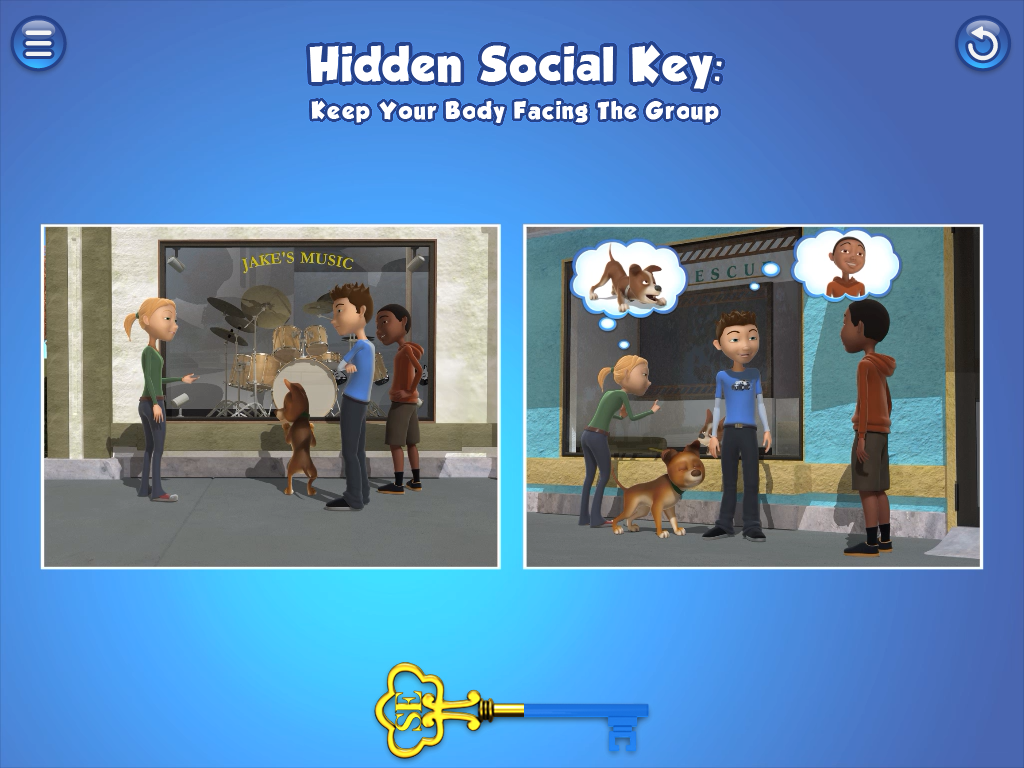
In short, The Social Express offers 16 lessons with a total of 30 scenes based on animations and selections of possible endings. Globally, it allows you to work on aspects like paying attention to what our partner is watching and saying, looking into the eyes of our party when he speaks, turning your body to focus the rest of the group, watching the emotions of others, managing anger situations with various coping strategies or talking about what others are interested in. The lessons show both positive and negative results for a given situation.
With explanations for the students mostly oral and in some cases in written language, The Social Express is targeted at children and youth with autism, Asperger, ADHD or other learning difficulties in social aspects that do have a good knowledge of language (English).
First, the user and the guide
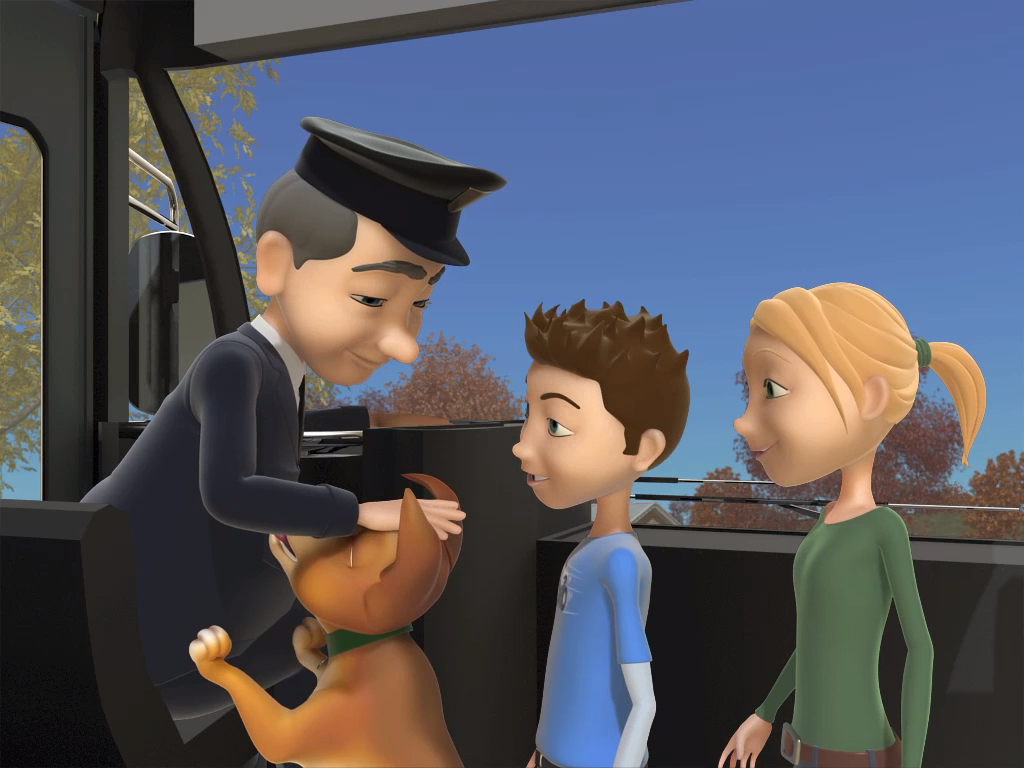
The Social Express is itself a bus. The app starts with the driver explaining what it’s all about and introducing the three main characters: Zack, Emma and their dog Sunny. The three will take the bus to the city, where they will experience many social situations.
The first thing to do once you have seen the initial presentation is to create a user profile, which in itself is a combination of a first name and a last name.
Later, from one of the main menu options, you can add other users, and edit, delete or select them.
Also in the main menu, you have access to the The Social Express Guide. One of its sections outlines how the application should be used in the sense that it is intended as a support for sessions in which the student is accompanied by an adult who can help, ask questions or propose alternatives to the ends of each scene proposed by the app. The website of the company, which again has a great graphic quality and content, includes more information on the app, its educational approach, …
The longest portion of the guide shows a tab for each of the 16 lessons that The Social Express includes. In each tab is a summary of the lesson, its objective, the key hidden social and a proposal for additional activities. These activities include dialogues on the subject, looking at books or videos to look for similar situations, working with the printable material including application, etc.
Finally, there is a credits section of the app, which shows the team of more than 25 people involved in the project.
Lessons
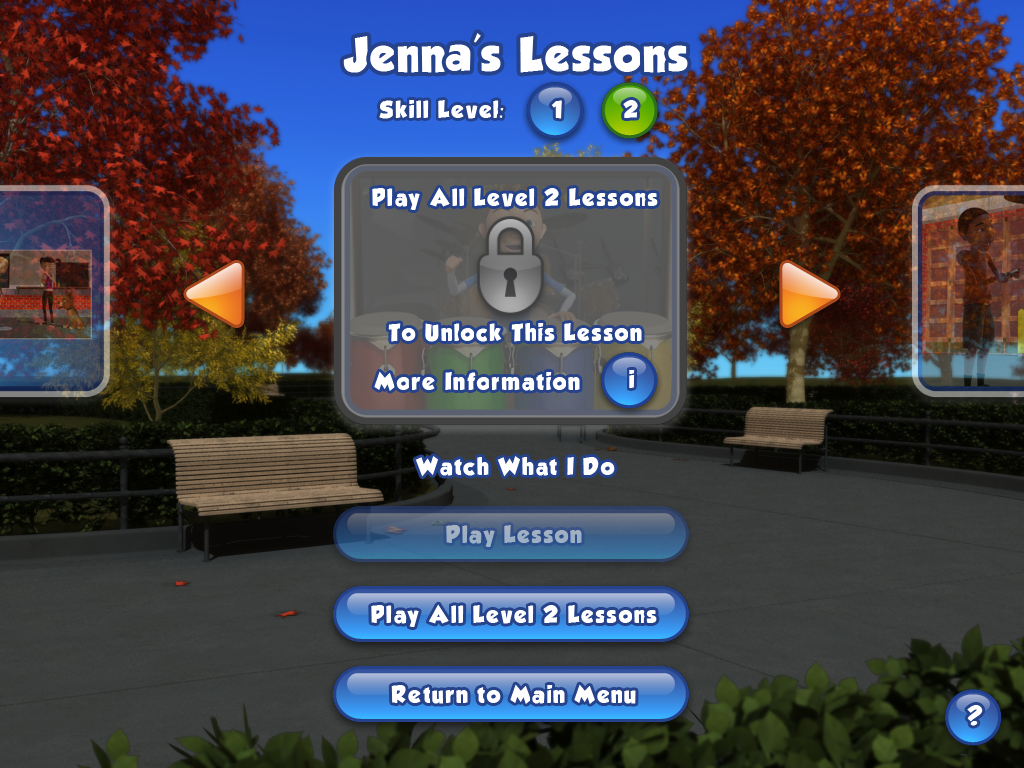
And then comes the most important part of the app. The Social Express has 16 lessons on topics grouped in two skill levels. The first time, it shows some short messages that explain how to interact with the lessons menu, which is really easy to use. After that, an icon with a question mark allows you to repeat those explanations as many times as you want.
Starting at level 1 and the first lesson, you will see an animation of the three main characters. They want to go to the city and are aware that they have to take care of their social modes.
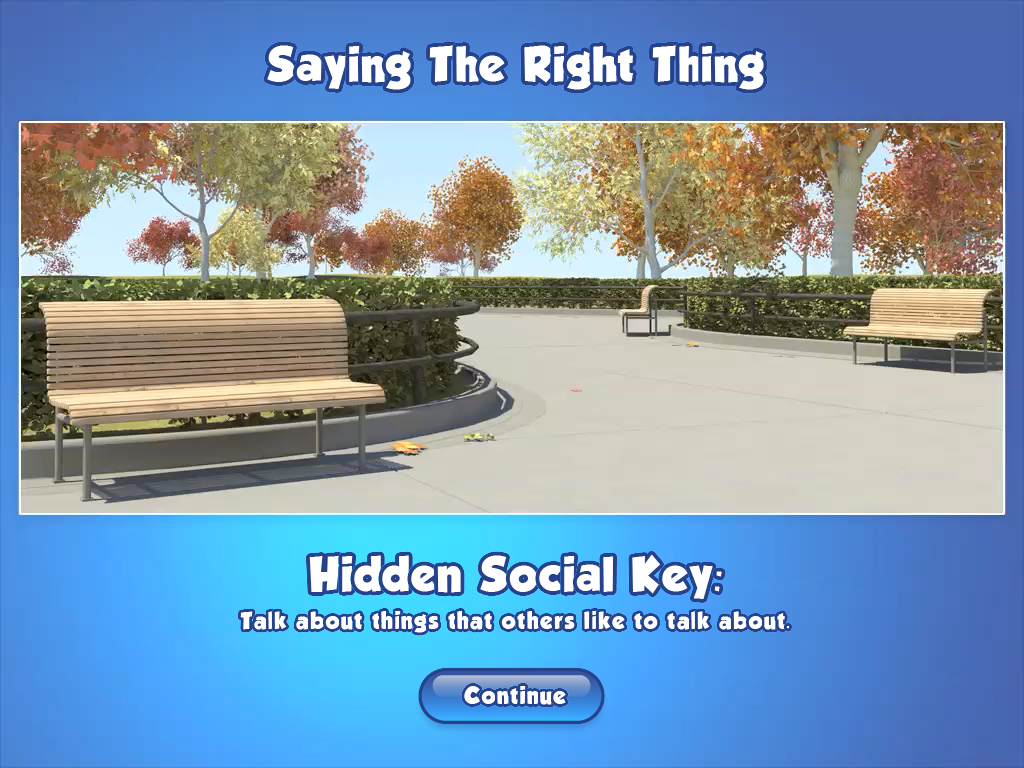
So they take the bus. And you see a screen that displays the title of the first lesson and the hidden social key. You can also see a message with tips for the teacher / adult (that can be disabled if you want).
And the lesson starts. Zack asks Emma what is she thinking about, and Emma tells him to try to guess, while she looks at the bell. The graphics are nice, with characters well designed, especially the expressions on their faces, which clearly show the emotions of the characters. The images are visually rich, but with relatively soft colors hat give a feeling of cleanliness and simplicity.
If the user points to the fire truck, for example, the background voice that narrates the scene will explain that it was not a correct answer. Emma is really thinking on the bell, and she and Zack will show a sad expression and gesture. By selecting the bell, the voice will explain that you are right and give some additional social explanations. The bell will ring at the time a dotted line is drawn from Emma to the bell.
The lesson does not end there. The main characters follow visiting the town. Two friends will appear in up to four other scenes where a character looks at a specific point in the scene and the student should touch that point, while the background voice remembers the student that they always has to look at their partner to guess what they think.
And so, the student has to continue with the other lessons. The second lesson is about facing other people when they are talking to us. It shows a scene where Emma is distracted and stops looking to the others, causing their displeasure until Emma makes the decision (of two possible that are presented graphically) to rejoin the group.
This lesson is short. The third, which features characters in situations that provoke different emotions, has again multiple scenes.
I will not explain all the lessons one by one, but comment some additional aspects. The fourth lesson shows a situation where Zack gets mad. The solution here consists on using a virtual iPhone, which has an app called DPS or Digital Problem Solver. This app does not really exist, so do not look for it in iTunes (I’ve done it myself, believe me), but it is expected to appear in a month at a price of about $5. DPS has two possible coping strategies when you are mad: to use kind words, and to take five deep breathes to calm down. For each emotion, DPS has a small repertoire of coping strategies. Since DPS is used in several lessons, it is logical that some students want to have it in real life, so I expect to see DPS soon in iTunes.
Other lessons show a situation to immediately overlay it with a sequence of two small images and two possible endings for that short sequence. The student has to touch which of those images is the right end.
Always on the screen you will see two buttons: a pause button to stop the lesson and another to access a menu that allows you to turn on or off the hints for the teacher, to start the lesson again or to go back to the main menu of The Social Express.
Levels
At the end of the eight lessons of Level 1, the bus driver makes a short summary of what has you learned and makes you to do a test review. In that test the student will see bits of previous scenes and will have to choose which one of each pair shows the right social behavior.
As the student gives right answers, the key that appears below becomes gold. When finish the test, the student gets a certificate for completing it that they can print later.
Once you finish the level, it is unlocked, so you can select from the menu which lesson you want to practice. You can also repeat all the level or start the lessons from the Level 2.
Level 2 and printing
The eight lessons of level 1 allow you to practice the considered most basic social scenes. At level 2, it some knowledge of social rules is assumed and the student has to work on how to apply them in more real-life situations.
The second group of lessons is also a bit different in its operation. In the first lesson, Zack plays drums and the student must imitate the movements he does. The rest lessons show similar but more difficult social situations. So, for example, when using the DPS, the student now has to find the emotion and not just select a coping strategy. Another lesson is devoted about the interpretation of idioms.
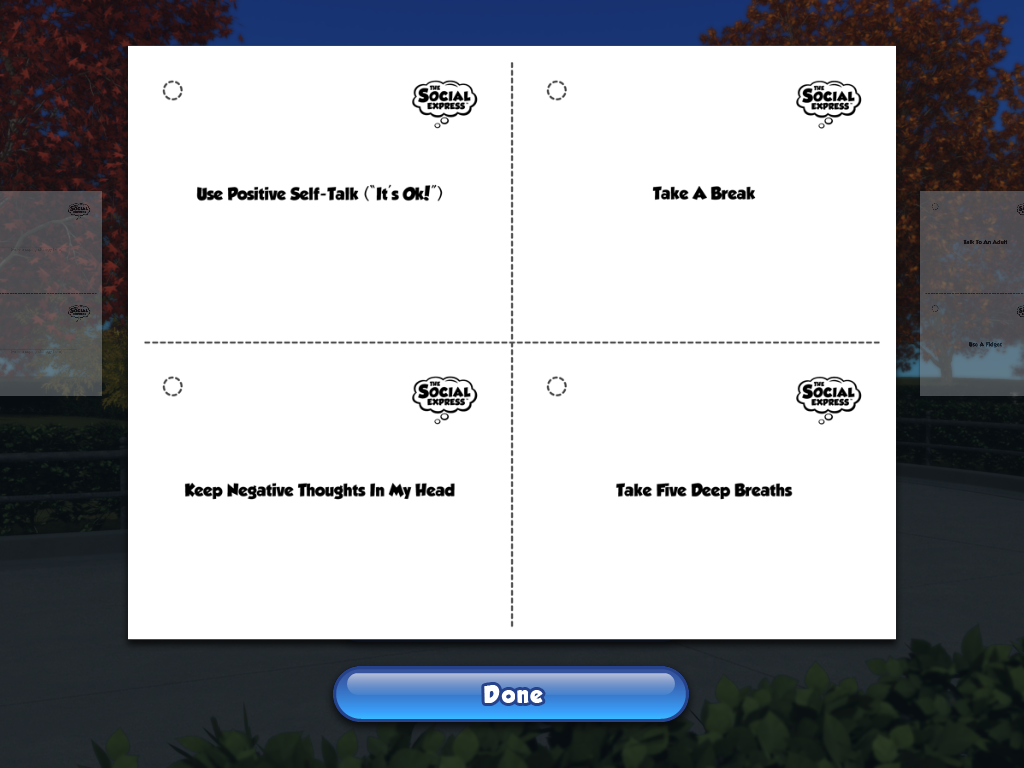
The Printables option of the main menu of The Social Express is another nice feature of this app. By using the AirPrint system that Apple incorporates in its iOS operating system, you can send different material to a printer with WiFi and support for AirPrint or to another printer attached to an Apple computer with WiFi.
So, for example, you can print the certificate of having finished each level.
You can also print two sheets with the characters and their emotions, three with the coping strategies to follow in certain situations (from the DPS), one with social cues and five with the profiles of each of the characters. For each type of document there is also a blank template that you can print as a basis for creating new exercises.
Assessment
The Social Express is a very carefully designed app. The screens, buttons and messages, the background jazz music or the animations make me to think the company has devoted many resources. For the users, it is excellent news that apps like this appear.
From an educational point of view, the curriculum of The Social Express allows you to work with some social skills with the advantage that you can see the effects of wrong choices (based on seeing clearly displayed characters angry or sad) and not only happy faces when you select the right solution. With 16 lessons and 30 scenes, and two or more possible endings for each scene and the final exercises of each level, the app provides many hours of educational work. The tabs of each lesson provide clues for complementary activities that can be performed after each lesson, which in some cases involve printing sheets that already includes the application itself.
I can hardly criticize aspects of The Social Express. Well, I wish I could turn off the background music, although it is very nice –and can be bought as a music CD for $9.99– and I wonder if the characters should speak a bit slower. But the truth is that what I really want to see is the DPS app and a second part of The Social Express with 16 lessons more (and, of course, the option of working in other languages).
And I am thinking on the second part because The Social Express takes 1.79 GB. It is by far the largest app I have installed on my iPad, and its size approaches dangerously the 2 GB limit imposed by Apple, so there is not much space to grow. Its size is also what made Apple to categorize the content for people with more than 17 years, but the app does not include any sexual content or anything that is not suitable for children.
As always, the reader has the last word. The authors of The Social Express have made it easy, since they offer a Lite version with only two lessons (also available for PC and Mac). I recommend downloading it, so at least you can see how apps for the iPad are evolving and what you can expect in the exciting future of tablet apps. Or you can also watch a demo video in the company’s website. It is worthwhile, I assure you.
-Francesc Sistach[/vc_column_text][/vc_column][/vc_row]


 Hi Everyone, We just received our first volume purchase from a school! Get The Social Express for 50% buying 20 or more! To Do this (FOR NOW) Go to itunes, search for The Social Express, then click on the drop down arrow and select copy link, then paste that link in the Volume Purchase Portal or