cropped-Sepcial-Education-degrees


A great post by Cara Delany
Science of Learning Disabilities
Source: Special-Education-Degree.net

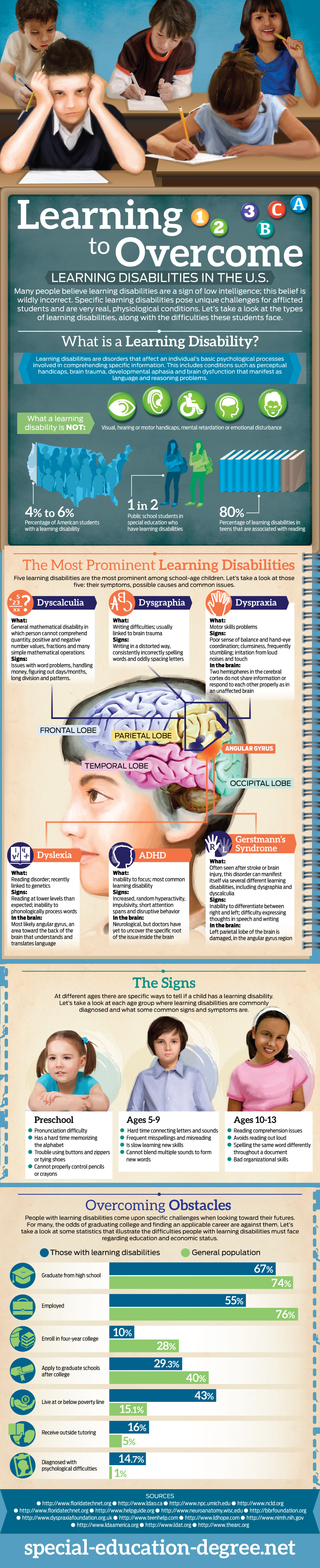
Learning Disabilities in the U.S.

Many people believe learning disabilities are a sign of low intelligence; this belief is wildly incorrect. Specific learning disabilities pose unique challenges for afflicted students and are very real, physiological conditions. Let’s take a look at the types of learning disabilities, along with the difficulties these students face.
What is a Learning Disability?

Learning disabilities are disorders that affect an individual’s basic psychological processes involved in comprehending specific information. This includes conditions such as perceptual handicaps, brain trauma, developmental aphasia and brain dysfunction that manifest as language and reasoning problems.

What a learning disability is NOT:

Visual, hearing or motor handicaps, mental retardation or emotional disturbance

4% to 6%

Percentage of American students with a learning disability

4.6 million

People in the U.S. with learning disabilities

1 in 2

Public school students in special education who have learning disabilities

80%

Percentage of learning disabilities in teens that are associated with reading
The Most Prominent Learning Disabilities

Five learning disabilities are the most prominent among school-age children. Let’s take a look at those five: their symptoms, possible causes and common issues.

Dyscalculia

What: General mathematical disability in which person cannot comprehend quantity, positive and negative number values, fractions and many simple mathematical operations

Signs: Issues with word problems, handling money, figuring out days/months, long division and patterns.

Dysgraphia

What: Writing difficulties; usually linked to brain trauma

Signs: Writing in a distorted way, consistently incorrectly spelling words and oddly spacing letters

Dyspraxia

What: Motor skills problems

Signs: Poor sense of balance and hand-eye coordination; clumsiness, frequently stumbling; irritation from loud noises and touch

In the brain: Two hemispheres in the cerebral cortex do not share information or respond to each other properly as in an unaffected brain

Dyslexia

What: Reading disorder; recently linked to genetics

Signs: Reading at lower levels than expected; inability to phonologically process words

In the brain: Most likely angular gyrus, an area toward the back of the brain that understands and translates language

ADHD

What: Inability to focus; most common learning disability

Signs: Increased, random hyperactivity, impulsivity, short attention spans and disruptive behavior

In the brain: Neurological, but doctors have yet to uncover the specific root of the issue inside the brain

Gerstmann’s Syndrome

What: Often seen after stroke or brain injury, this disorder can manifest itself via several different learning disabilities, including dysgraphia and dyscalculia

Signs: Inability to differentiate between right and left; difficulty expressing thoughts in speech and writing

In the brain: Left parietal lobe of the brain is damaged, in the angular gyrus region
The Signs

At different ages there are specific ways to tell if a child has a learning disability. Let’s take a look at each age group where learning disabilities are commonly diagnosed and what some common signs and symptoms are.

Preschool

Pronunciation difficulty
Has a hard time memorizing the alphabet
Trouble using buttons and zippers or tying shoes
Cannot properly control pencils or crayons

Ages 5-9

Hard time connecting letters and sounds
Frequent misspellings and misreading
Is slow learning new skills
Cannot blend multiple sounds to form new words

Ages 10-13

Reading comprehension issues
Avoids reading out loud
Spelling the same word differently throughout a document
Bad organizational skills

Overcoming Obstacles

People with learning disabilities come upon specific challenges when looking toward their futures. For many, the odds of graduating college and finding an applicable career are against them. Let’s take a look at some statistics that illustrate the difficulties people with learning disabilities must face regarding education and economic status.

Those with learning disabilities General population

Graduate from high school 67% 74%

Employed 55% 76%

Enroll in four-year college 10% 28%

Apply to graduate schools after college 29.3% 40%

Live at or below poverty line 43% 15.1%

Receive outside tutoring 16% 5%

Diagnosed with psychological difficulties 14.7% 1%

SOURCES:

http://www.floridatechnet.org

http://www.npc.umich.edu

http://www.floridatechnet.org
http://www.helpguide.org
http://www.neuroanatomy.wisc.edu
http://bbrfoundation.org

http://www.ldhope.com
http://www.nimh.nih.gov

http://www.ldat.org

learning-disabilities-thumb
Proudly powered by WordPress

We would like to welcome our first guest blogger to The Social Express…
Marcela De Vivo

How Inclusion Can Benefit Special Needs Children Socially

Inclusion is a hot issue in education as of 2013 and it has been for years. While many don’t fully understand the idea of inclusion, it’s a topic that most parents of children with special needs are familiar with.

Inclusion is a simple principle that states children with special needs should take part in regular classes and activities – just like children their age without special needs. Some proponents of inclusion believe it should be based on ability – others believe all children with special needs should experience standard classroom education.

Inclusion involves more than just education for many parents and children with special needs, however. Regular classroom settings and participation in activities may be beneficial for helping children with special needs develop better social skills as well.


Proponents of inclusion believe the classroom offers a blank slate for special needs kids.
Image Courtesy of Wikimedia Commons

Children Learn By Example

Whether they learn certain behaviors from their family and parents, peers and schoolmates or teachers and authority figures, children learn how they’re supposed to behave based on examples that are set forth for them. For many children with special needs in special classes, the example set for them there on a daily basis is simply other children with special needs, therefore, they become accustomed to that restricted environment.

While special needs children can benefit from spending time with other special needs children, problems can arise when they spend all of their time with children with similar behavioral issues. Inclusion improves learning for both classified and unclassified students. After all, many children learn by example and they may begin to imitate behaviors that aren’t beneficial for them.

By being in a classroom with children that don’t have behavioral issues, some individuals with special needs may be able to develop better social skills through example. When children who have learning problems are included, students without disabilities tend to perform better academically. For example, a teacher is more inclined to break instruction into finer parts or repeat directions if he or she has a student in the room who is deaf, blind or has a developmental disability.

Inclusion Helps Children Adjust

The issue of inclusion is passionately debated, but most advocates believe that attending regular classes and spending time in standard classroom settings, even if they don’t do it full-time, can help children with special needs better adapt to the rest of the world – a world that is predominantly made up of others that do not have the same needs.

Many advocates of full inclusion believe that special needs children who attend regular classes will be better equipped to handle the world in their teen and adult years due to their exposure to children without special needs. For many children with developmental disorders who may be working to overcome them, that means easier friendships and work situations later in life, and less overall shock when it comes to adapting to the world later on.

It Goes Both Ways

Children with special needs may be able to develop better social skills by attending regular classes and spending time with other children that do not have special needs, but the issue goes both ways. One thing that many advocates of inclusion tend to forget is that children who do not have special needs can also develop better social skills and empathy by being in classrooms with special needs children.

Both partial inclusion, sometimes referred to as mainstreaming, and full inclusion are becoming more and more common in schools throughout the United States, and even in foreign countries around the world.

While there are parents and educators on both sides of the fence, it’s difficult to ignore some of the statistics that state inclusion is beneficial for the educational and social development of special needs children.


Image Courtesy of Wikimedia Commons

Marcela De Vivo is a freelance writer from Los Angeles who covers various industries, including health, marketing, special needs law and more. As a mother of a child with special needs, she helps to educate other parents with special needs children about inclusion and special needs law.

If you’re looking to help your child learn social skills, our online engaging animated program may benefit your child. Parents tell us that kids love the Hollywood style animation and characters and actually ask to use The Social Express! To see how it works, click here.   Click here to try our 10-day, no risk trial.


Review of The Social Express – Best Social Skills apps for Teenagers

By Helen Wagner

Overall Impression

This is the most comprehensive social skills app which I have found, to date. I highly recommend it to SLP’s, parents and teachers of socially deficient students. It’s lessons must not be rushed through.

Overall Rating: 5

Appy Ratings (Appy’s):
•Educational Value: 5
•Entertains/Engages User: 5
•Customization/Settings: 5
•Value for the money: 4
•Ease of Navigation: 5
•Quality of Graphics: 5
•Overall Rating: 5

Category:
• Social Skills

Goals:
•Comprehension
•Emotions
•Problem Solving Skills
•Wh Questions
•Social Skills Development

Age Group:
•Lower Grades (Age 6-8)
•Upper Grades (Age 9-10)

Overview

The Social Express is a unique movie-like set of interactive training/practice lessons in using Hidden Social Keys or rules, in order to enable users to become more socially competent and to fit in with a group. It is intended for elementary to middle school aged learners who do not understand unspoken social rules. The Hidden Social Keys are: Keep your body facing a group; Look at who is talking; Use your eyes, ears and brain to figure things out; Talk about what the group is talking about, Monitor and adjust your behavior when you’re with a group; Look at what others are looking at; Try to figure out what to do based on how others are feeling; and talk about things that others like to talk about. There are two levels of instruction to choose from, depending on the severity of the social delay. The app is designed to be completed with a teacher and a learner working together to explore a variety of social situations. The user makes choices about what should be done in given social situations. The teacher and learner discuss the different scenarios presented and problem solve together to determine the appropriate course of action in various social situations. A pause button allows discussion and questioning during each activity. 12 coping strategies are also taught. The program comes with an online user guide, printables (achievement awards, feelings cards, coping strategies, hidden social keys cards, and character profiles). Emma, Zack and their dog are the featured, animated characters who are faced with social scenarios in a realistic environment/world. The characters use a hand-held “Digital Problem Solving” device to make appropriate behavioral decisions. A matching app called DPS
(Digital Problem Solving) can be purchased separately to go along with the use of Social Express. The Social Express provides for specific practice of social skills.

[vc_row][vc_column][vc_column_text]This article about our social skills learning software was published in the Greater Wilmington Business Journal

Unhappy with the quality of software games available for children with autism, a team that includes a Leland resident set out to make its own.

The software developed by The Social Express uses animation to help children on the spectrum learn to interact with others in a more typical manner.

Identifying feelings in others, being part of a group and figuring out the hidden rules of social interaction are some of the social skills the software teaches, said Jon Cornick, president and COO of The Social Express.

One of the big deficits of kids that are on the spectrum is identifying non-verbal social skills. All of the areas are targeted with our program,” said Cornick, who is based in Leland. “We are combining the best practices to create our lesson plans.

The Centers for Disease Control and Prevention defines autism spectrum disorders as a “group of developmental disabilities that can cause significant social, communication and behavioral challenges,” and according to a CDC study last year, an estimated 1 in 88 children in the United States has been identified with an autism spectrum disorder.

While scientists do not have a clear understanding of what causes the disorders, parents have found that software can help children learn valuable social skills, Cornick said.

Cornick said that he came to the company after a career of producing movies, joining the founders Marc and Tina Zimmerman when the software launched in 2011.

“One of my dearest friends is Marc Zimmerman, who had this idea to create The Social Express. He needed animators and engineers. I was in between films in 2011, and I came on at the launch,” Cornick said.

The Zimmermans have autistic twin boys and found that they responded well to software used by after-school therapists.

“The children were mainstreamed in their local public school, and the behavioral issues were in check, but their social and emotional skills were a real deficit,” Cornick said.

Marc Zimmerman, a software entrepreneur and professional musician, sought to design a better alternative to the software available for children with autism.

Today, the software is used by more than 200 school districts, Cornick said, and is available on Macintosh, PC and iOS (iPhone and iPad).

The 2.0 version of the software is due out soon and will shift to a web-based, subscription version with new features. Cornick said the web-based model would allow for more frequent updates and more lessons and would include a special protected social network for children who use the program, called the Club House.

“One of the real problems is that most of these kids have few or no friends,” Cornick said. “We have created the Club House to have a way for kids to connect.”

Websites used by children under 13 are required to follow special guidelines outlined in the Children’s Online Privacy Protection Act (COPPA), and the software requires parents to approve their children’s access.

“Because the parent’s email is attached to the child, we have a parent portal, and they can see every conversation their child is having. Children have the option to flag inappropriate conversations, and both parents are notified,” Cornick said.

The Social Express has offices in Leland (with Cornick) and California (with the Zimmermans) and employs between 12 and 17 people depending on workload.

“We have 16 lessons with 30 interactive scenes, and we are animating 10 more now,” Cornick said.[/vc_column_text][/vc_column][/vc_row]

San Diego, CA (PRWEB) January 31, 2013

The makers of The Social Express® are pleased to announce that three school districts in Maine and California have signed on to pilot their newest education technology in February 2013. These school districts will have early access to the upcoming Web-based version of the company’s well-received social skills learning program.

The school districts participating in the new pilot programs include South Portland, Maine; and both Encinitas and Solana Beach, California.

The Social Express, winner of the SIIA Innovation Incubator Award in Ed Tech, is an interactive social skills learning program. The Social Express targets core deficit social skill areas that stand in the way of school and life success for children and young adults with social learning challenges.

The newest program from The Social Express provides teachers and professionals with reporting summaries that are relevant to them. This internet-based interactive education technology tool aligns with the Common Core State Standards (CCSS), an initiative that is already being implemented nation-wide in the public schools. This new feature of the program will make writing social skill educational goals and reporting on progress easier for all professionals working with their students.

The Social Express will continue to incorporate the best evidence-based social learning practices to help students improve their use of social skills across all learning environments. Students work on “hidden social keys” such as making eye contact, recognizing non-verbal language cues from others, and turn taking, to name a few. The new program enables school districts to offer all of its students and teachers an updated social skills teaching method that uses a single sign on and minimizes IT costs.

Tamara Green, M.S., CCC-SLP and Content Director for the company said, “The benefits to students, teachers and professionals using this program are numerous. We know how valuable social skills are to succeed in our fast-paced world. An unfortunate reality is that socially rejected and socially isolated children and young adults with social learning challenges are at risk for academic failure and social adjustment problems. We are dedicated to meeting the growing need for explicit social skills instruction. Our research-based program is influenced by learning frameworks and methodologies from experts in the fields of education, social communication and psychology.”

Green continued, “Our lessons target the skills necessary to being a good social communicator. Our goal is for children to become more confident in using their social communication skills and carry over these skills wherever they go. Through explicit video modeling, individuals learn how to make friends and keep friends.”

Teachers, administrators and school professionals in each district will access the new Web-based version of The Social Express from all desktop computers and laptops. No special software needs to be loaded on each computer. The new program retains the wonderful characters that users love, and offers the same interactive learning environment.

Professionals and educators piloting the new Internet-based program will use integrated tools to create custom learning plans individualized for each student. They’ll also have access to new content each month and the popular built-in teaching tips.

Since launching in November 2011, The Social Express has received worldwide support and heartwarming testimonials. Stories of progress and success have poured in from Speech-Language Pathologists (SLPs), behaviorists, educators and parents. Children with Autism Spectrum Disorders (ASD), ADHD, learning disabilities, and normally developing children have found help using the program.

The Social Express is an interactive video-modeling intervention for parents, professionals, educators and the children they work with. Those that have worked with The Social Express have come to appreciate the high-quality, Hollywood-style animation and socially relevant content. It not only holds the user’s attention without over stimulating the senses, but also provides learning scenarios that reinforce best social choices. Learn more about The Social Express by visiting: thesocialexpress.com Twitter: @TheSocialExpres

About Brighten Learning, Inc.:

Brighten Learning®, founded by parents of autistic twins in 2010, is a privately held company based in Encinitas, California. The company develops The Social Express® and other interactive social skills software and learning management systems. The company’s mission is to help special needs children with social-emotional deficits to improve their lives. The company’s video modeling social skills learning programs help children with ADHD, Autism, Asperger’s, and related disorders to improve their interactions with others. Visit the company at http://thesocialexpress.com/

The Social Express Web-based Version Coming SoonThe new Internet-based version of the popular social skills learning program, The Social Express, will be offered soon for Families, Professionals and School Districts.

An added feature, ‘The Clubhouse’, provides a safe environment for kids who are members to connect with each other and engage while practicing social skills.

Quote startThe upcoming Web-based, subscription version of The Social Express makes it easier to reach many more children and young adults who need help learning and practicing social skills. We want to help as many kids as possible to better interact with others.Quote end

 
San Diego, CA (PRWEB) January 25, 2013

Brighten Learning, makers of The Social Express®, is pleased to announce that a new Web-based version of its social skills learning program is coming soon.

The Social Express, winner of the SIIA Innovation Incubator Award in Ed Tech, is an interactive program that targets core deficit areas that stand in the way of school, social, and life success for children and young adults with social learning challenges.

Marc Zimmerman, CEO, said, “We’re so humbled by the community of parents, professionals and teachers that have gathered around The Social Express. We’re thrilled to be able to convert our social skills learning software into an Internet-based program. The upcoming Web-based, subscription version makes it easier for us to reach many more children and young adults who need help learning and practicing social skills. We want to help as many kids as possible to better interact with others.”

Families, Professionals and School Districts will be able to access the new Web-based version of The Social Express from all desktop computers, laptops and selected mobile devices. The new program retains the wonderful characters that users love and offers the same interactive learning environment for children to use along with their parents, teachers and speech language professionals.

Parents, school districts and professionals who become members of the new Internet-based program from The Social Express will be able to create custom learning plans around their children’s needs for social skill improvement. They’ll also have access to new content each month and the popular built-in teaching tips.

Jon Cornick, President and COO, said, “We developed the Web-based version to make it easier for children who need help with social skills to learn, connect and engage. One example, ‘The Clubhouse’, is a new private social network exclusively for children registered in The Social Express program. Inside The Clubhouse they can engage with each other while practicing the very skills they have learned in The Social Express. The goal is for them to generalize these new skills and ultimately make friends. The Clubhouse provides a safe and fun environment for this, and there is even a Parent Login for observing the child’s progress.”

Cornick added, “We’re developing exciting new tools and ways for kids to get involved with both learning and practicing social skills in our upcoming version of The Social Express. We invite our community of parents, educators and professionals to stay tuned to our exciting announcements. “

Since beginning in November of 2011, The Social Express has received wide support and heartwarming testimonials. Stories of progress and success have poured in from Speech-Language Pathologists (SLPs), parents and teachers of children diagnosed with Asperger’s, ADHD, autism and related disorders who have found help using the program.

The Social Express is an interactive video-modeling, social skills learning and education for autism program. Parents, professionals, and educators of special needs children like the high-quality, Hollywood-style animation that holds their attention without over stimulation. They also like the scenes that reinforce the best choices for kids to make in social situations. Learn more about The Social Express by visiting: thesocialexpress.com Twitter: @TheSocialExpres
Or follow the company on Facebook

Join our mailing list to hear exciting about new announcements and special offers from The Social Express! Click here to join our mailing list.

About Brighten Learning, Inc.:

Brighten Learning®, founded by parents of autistic twins in 2010, is a privately held company based in Encinitas, California. The company develops The Social Express® and other interactive social skills software and learning management systems. The company’s mission is to help special needs children with social-emotional deficits to improve their lives. The company’s video modeling social skills learning programs help children with ADHD, Autism, Asperger’s, and related disorders to improve their interactions with others. Visit the company at http://thesocialexpress.com/


AppAbled-blog-autism-softwareWe were so touched by this heartfelt post by a mom who has a young son with autism. Julie-Anne shares how much the world of Apple technology, autism software apps, and iPads have enriched her son’s life. These devices and autism software made it possible for her son to communicate with his family, therapists and others.

We’re also honored that Julie-Anne included our autism software program, The Social Express, in her post! As both parents of twins with autism and program developers, we understand the need to reach more and more families with helpful autism software.

Here is Julie-Anne’s post. You can also visit her wonderful app review blog, AppAbled by clicking here: http://appables.blogspot.ie/

On her blog, Julie-Anne provides App Advice for the Special Needs Community. AppAbled, autism software apps reviews

How my love for apps came to be ~ Julie-Anne

I sat down tonight to write a review, but my mind kept wandering else where. I realised that for the past few months I have been writing and talking about apps all day everyday, yet I have said very little about how I became involved in this world of technology.

Most people already know that my son David, aged 9, has Autism. David is the most beautiful, funny kid you could ever meet. He has changed my life forever.

At the age of 3 1/2 David was diagnosed with Autism and severe receptive and expressive language delay. The therapist was unable to complete parts of the evaluation process as David’s language and attention span was so poor back then. We knew he had a love of animals, dvd’s and certain foods but there was so much about my son that we had yet to learn as he was unable to tell us.

At the time we had started to use pecs (Picture Exchange Program) in the hopes of breaking the cycle of hand grabbing and acts of aggression as a form of communication.  It was as if David was trapped in a bubble trying to break out and have his voice heard.

After a few months of using this method it was proving to be quite a chore dragging pecs books around with us. One night I was chatting to some fellow Autism parents and one of them happened to mention the iPod and the Grace App. The whole world of Apple was alien to me. I couldn’t work out how this tiny little device would allow my son to communicate.

A few weeks later I watched a news bulletin about the release of the Grace App and mentioned it to my brother. He kindly donated his own iPod touch to David and low and behold our first introduction to the world of Apple took place. Grace App revolutionised the way my son communicated. Within a matter of weeks he was able to use it to ask for everyday essentials.

As time past we bought more and more apps. At the start it was all very much trial and error when it came to buying apps. Ultimately we wanted to zone in on areas that needed attention most and balance those needs against apps available. Very quickly my son progressed from having little or no writing ability and fine motor skills to being able to write unaided in his school books. His language increased and as a result his levels of frustration waned. Through apps like The Social Express David’s social skills and understanding have improved. He is now able to hold a two way conversation to a certain degree.

David currently has an iPad for home and one for school use as well. All of these devices are due to the incredible generosity of friends, family, Irish Autism Action and even strangers who helped to collect phones needed to get David his iPad. David uses his iPad for maths, English, hand writing, reading and like every other child on this planet for his Angry Birds as well.

When I see my son lying on his bed reading a book app my heart jumps a little. He no longer has to worry about fumbling with pages whilst trying to focus on reading. I love listening to him laugh and watching him as the smile spreads across his face when he has completed a task on the iPad.

Today when someone ask me why I do what I do, my reply is always the same – ” If I can help even one child to gain their voice then I am doing something right”. The world of iPad and iPods has opened up a whole new world for my son and countless others. The possibilities of it are endless. There is an app for almost anything you need now. iOS gives the user a voice and the freedom to be heard. I have heard some incredible success stories from parents and therapists over the past few months and I am very grateful to have the opportunity to have met so many amazing men and women through the App world.

AppAbled, autism software reviews blog by Julie-Anne

Thank you all for allowing me to share my passion for iOS technology with you. I am not a teacher or a therapist, but merely a Mum who has seen first hand what these devices can do.

Julie-Anne

You can follow Julie-Anne on Twitter @App_Able or on Facebook
https://www.facebook.com/AppAble

photos courtesy of: http://appables.blogspot.ie/

We’re so excited that our social learning program is included in the Teachers with Apps Reviews The Social Expresslist of 12 Best Special Needs Apps of 2012! The post is by the Teachers with Apps team on their website.

We love being included with some of our favorite programs for special needs children. We’ve used learning programs by Conversation Builder and think that they build great programs to help children with language skills.

Here’s what Teachers with Apps had to say: The Social Express “Uses engaging scenarios to teach users, with high functioning Aspergers or other similar conditions, how to think about and manage social situations so that they are better prepared to develop meaningful social relationships and succeed in life.”

You can click here to read the full review.

Jon Cornick ,President, Brighten LearningOur president, Jon Cornick and I and our entire team were so excited  to celebrate the first anniversary of our company! The Social Express was one-year old on November 11, 2012. We actually celebrated at ASHA12!

We’re all so humbled by the wonderful reception our social learning program has received from parents, school administrators, and teachers in our first year. Also from the dedicated speech-language pathologist (SLP) community that provides help for Asperger’s and autism everyday. So many  children who need special assistance with communication skills rely heavily on SLPs and their teachers.

Thanks to everyone we’ve met at ASHA and other conferences.

Marc and Jon


Help for Asperger’s


PRWeb–November 29, 2012–The Social Express, a peer-reviewed program that recently won the coveted Software Information and Industry Association (SIIA) Innovation Incubator Award in Tech Ed, celebrates its first anniversary with a growing community of people helping kids to learn social skills.

The Social Express provides social skills help for Asperger’s and other children diagnosed on the autism spectrum. In its first year, The Social Express has received wide support and heartwarming testimonials from the autism and Asperger’s community of Speech-Language Pathologists (SLPs), educators, parents and teachers of children who need help for Asperger’s, ADHD, autism and related disorders.

Jon Cornick, President, said, “We are incredibly grateful for the amazing growth our company has achieved in our first year. We’ve found an enthusiastic community of supporters by participating in conferences, being featured in news stories, receiving wonderful reviews and publicity. The testimonials from educators, administrators, professionals and parents have been so encouraging.”

Marc Zimmerman, CEO, said, “My wife Tina and I were inspired to found our company in order to help other parents, like us, who have children with autism. We continue to be inspired, motivated and energized because of the deep commitment to help kids with autism and Asperger’s that we experience from the autism community.” Zimmerman continued, “We’d like to express our deep gratitude for all of the hard work the SLPs do everyday to help my twins and other children on the autism spectrum with communication skills.”

The Social Express is an interactive video modeling, social skills learning, and education for autism program. Parents, professionals, and educators of special needs children like the high-quality, Hollywood-style animation that holds their attention without over stimulation and the scenes that reinforce the best choices for kids to make in social situations. Learn more about The Social Express by visiting: thesocialexpress.com Twitter: @TheSocialExpres

About Brighten Learning, Inc.:

Brighten Learning™, founded by parents of autistic twins in 2010, is a privately held company based in Encinitas, California. The company develops The Social Express™ and other interactive social skills software and learning management systems. The company’s mission is to help special needs children with social-emotional deficits to improve their lives. The company’s video modeling social skills learning programs help children with ADHD, Autism, Asperger’s, and related disorders to improve their interactions with others.

If you have a child or a student who needs social skills help with Asperger’s, ADHD, autism or other related disorder, welcome! You’re in the right place. This is our blog for The Social Express.

What is The Social Express?

The Social Express is a new, unique software program designed to teach children social skills using fun, interactive play.  Our social skills learning program is comprehensive with 16 lessons and 30 scenes. It uses original, engaging, animated characters and video modeling to hold your child’s attention. Our social skills learning program is evidence-based and designed to be used by you with your child or student.

Parents tell us that our program provides help with Asperger’s because kids who need help learning social skills get really engaged with our beautifully animated, original characters like Emma and Zack. We hear the same feedback from, school administrators, teachers, and Speech Language Professionals (SLPs). You can see what others say about their children’s and students’ experiences with The Social Express by clicking here.

How Does The Social Express Help with Asperger’s?

If your child is diagnosed on the autism spectrum or with Asperger’s, he may not have developed the basic skills that will help him to make friends. He may need extra help to learn the social skills that can help him to interact successfully with his peers.  As a parent, The Social Express gives you a learning tool you can use at home with your child to reinforce the social skills he’s learning in therapy or at school.

If you’re a SLP or teacher, you can join many SLPs and educators who use our social skills learning program in sessions with their students.

The software targets core social deficit areas that stand in the way of school and life success for children and young adults with social learning challenges. That’s why it’s so helpful for kids diagnosed with ADHD and other related disorders. It provides help for Asperger’s by teaching your child how to think about and manage social situations.

The Social Express Provides Help with Asperger'sThe Social Express uses original characters and socially valid dialog to provide a fun and evidence-based teaching approach for children with Asperger’s and other social learning challenges. Many children enjoy the program so much, they ask to use it daily! The Social Express also helps children with nonverbal learning disabilities or pragmatic language deficits.

Our community of SLPs, educators, and parents also tell us that the social skills lessons are quite realistic. Each of the 30 scenes reinforces the best choices for kids to make in social situations. Parents, SLPs and teachers like that The Social Express holds children’s attention without over stimulation.

How does The Social Express help with social learning challenges?

The Social Express provides help with Asperger’s because it targets core deficit social skill areas that are often challenging for children. The interactive software learning program uses video modeling to help children to see how to improve their social skills in areas such as:

–       How to be with a group

–       Using your eyes to figure out what to say or do

–       Identifying feelings and coping strategies

–       Developing conversational skills

–       Using figurative language in conversation

And much more!

Award Winner

The Social Express is a peer-reviewed program that recently won the coveted Software Information and Industry Association (SIIA) innovation Incubator Award in Tech Ed. And what we’re really the most proud about are the positive comments we receive from parents and professionals who use it everyday to help children get better at making good decisions in social situations with their peers at school and at play.

Enjoy your visit to The Social Express! Let us know if you have questions by contacting us here: contact (at) thesocialexpress.com

You might enjoy checking out some of our most popular posts:

5 Tips to Help Your Child Make Friends

Seven Tips for Using iPads with Kids with Autism (and My Favorite Learning Programs)

Autism Help for Parents: Websites for Buying a Used iPad